Nightmares, photography, and the meaning of things
Before I went to sleep last night, I was reading Daniel Miller's The Comfort of Things, and had just finished the chapter on Mary and Hugh, two ex-publicans, and the many photographs that adorned their walls. It made me think about the photographs around me, in my own home, the recent additions, and what they represent. They sit in clusters, in different parts of the house, much like the places in my memory. Sometimes those images linger, as do the memories and thoughts attached to them.
That night, I had a nightmare. An awful, terrifying, scream-out-in-your-sleep nightmare. I was being slowly pressed, suffocated by unseen hands and arms that were pushing me into darkness.
I've had nightmares before, but not often, and I don't often scream or shout out, so this one was particularly troubling. I woke in the morning and felt my brain was under a cloud, and I considered what might have caused such a pronounced reaction and so clear a sense of fear and death.
When I was a child in Cyprus, around 5 years of age, I drowned in a swimming pool. The pool was concrete, a deep circular pool with narrow steps that led down to the bottom. On that day, my parents were filling it from a standpipe, an exciting summer prospect for us to play in. I had been left unattended, playing with the water as it gushed into the pool, when I fell in, unknown to anyone. I was floating somewhere near the bottom of the pool when I was found by my brother and sister and my father, who all managed to work together to get me out. My father gave me the kiss of life. My mother had run to the pool soon after, looked at me, my father pumping my chest, and turned away, thinking it was all over.
I have no recollection of that day, other than vaguely remembering the pool and how deep it was.
Sometime later I had my first nightmare, which I remember clearly. I was being pulled underground into water I had no sense of depth in, calling out for help. That feeling of being alone and scared. It seems likely to have been an after-effect of that day, an unconscious recollection surfacing as fear. So what does this have to do with photography?
Well, that sense of who we are, and our place in the world we inhabit, is largely shaped by the environment we live in: our home, and our connection to the past, with relatives, friends, places, all most commonly represented by the photographs we put on the mantlepiece, or the wall, or the bedside table. These photographs give us a sense of our past, and what got us to this present moment. They are reassuring, but ultimately represent the fragile nature of time and the inescapable march of it. They remind us all that we are here, for now, but we won't be forever. Photographs of relatives who have passed away are the clearest indication of this, as those moments give us reason to think of them, even fleetingly.
I recently was given two boxes of photographs that were my late father's, salvaged from a house clearance. I didn't expect them, as it had been over 5 years since my father passed away. Along with the photographs was an old pickle jar, with the remains of his ashes in them. Again, I did not expect that, as I had assumed his ashes had been scattered. The background to what happened after he was cremated is not really important now, so I won't go down that road; however, the fact that his ashes were now back in my possession, alongside all these photographs, gave me pause to think about the past, and forced me to consider this collection and what I should do with it.
Initially I went slowly through the photographs, lingering on some, shuffling quickly through others. All of them meant different things to me, but all of them reminded me that I won't be here at some point, and what will others do with all the photographs that I take, or have taken? Will they preserve some and throw away the vast majority? What will those photographs that mean something to me, mean to others? Are they important or not? Perhaps they will sort them into batches and put them through the letterboxes of unsuspecting friends and relatives, and see what they do with them. I found that thought quite intriguing. I reflected on Roland Barthes and his book Camera Lucida. That sense of punctum seemed to run through the whole unexpected collection, and through my own thinking about the photographs I've taken.
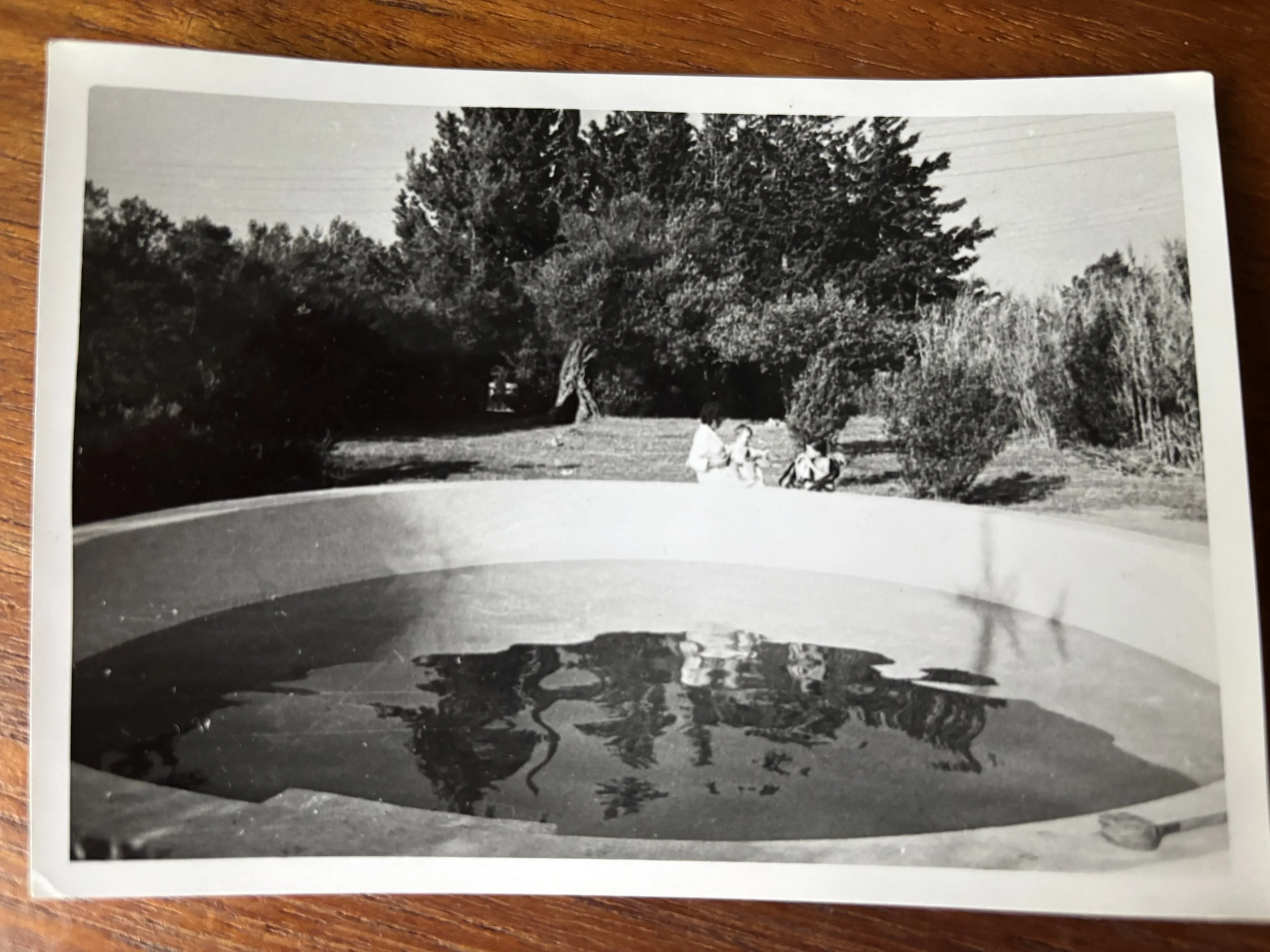
The Pool, 1968. Approximately 3 years before I drowned in it.
Then, in among those same photographs, was a photo of that concrete pool! The pool I drowned in, and most likely the reason I experienced my first nightmare. What did this photograph say about me and that time, and what does it still mean? My father had probably looked at this photograph at some point, and thought back on his own memory of that event and the outcome of my survival. It could have been very different. This photograph could have been all that was left of a place where he'd lost a son, but instead it was just a photograph of a pool which means nothing really, to anyone else.
It's been about 15 or 16 years since Daniel Miller first published The Comfort of Things, so reflecting on Mary and Hugh's story, it may well be that this chapter is now something of an epitaph to them, assuming perhaps one or both have died in the years since Miller wrote the book. If that's the case, I wonder what happened to all their many photographs. Did relatives sort through them, keep some, dispose of others? They had no children of their own, so perhaps most or all were thrown away; many of the photos were of places and people they'd met during their publican years, and would simply mean nothing to anyone else. There was one photograph among my father's that I instinctively knew wasn't his: a photo of someone else's children, a happy image, but of no one I think my father knew. It was perhaps a photograph of another family entirely that had somehow crept into this collection I'd assumed was purely my own. It meant nothing to me, but must mean something to someone else. I considered throwing it away, then salvaged it from the bin. It felt wrong to do so. Such are the hard choices. Perhaps I was too closely reflecting on my own memories through these photographs to feel comfortable throwing this random one away. Perhaps the idea of my own photographs, batched together and dropped through the letterboxes of friends and family, isn't such a bad one after all; it would push this dilemma onto someone else, better placed to make the call.
In the meantime, these photographs from my father are still with me, even the random one. I still don't know how to navigate this delayed "gift." As I continue to develop My Father, My Son, it will likely become clearer. I have some ideas too around inheritance, legacy, and family photographs, a new project, What We Carry. Perhaps that will be the answer. Let's see.
Max McGonigal © 2026
