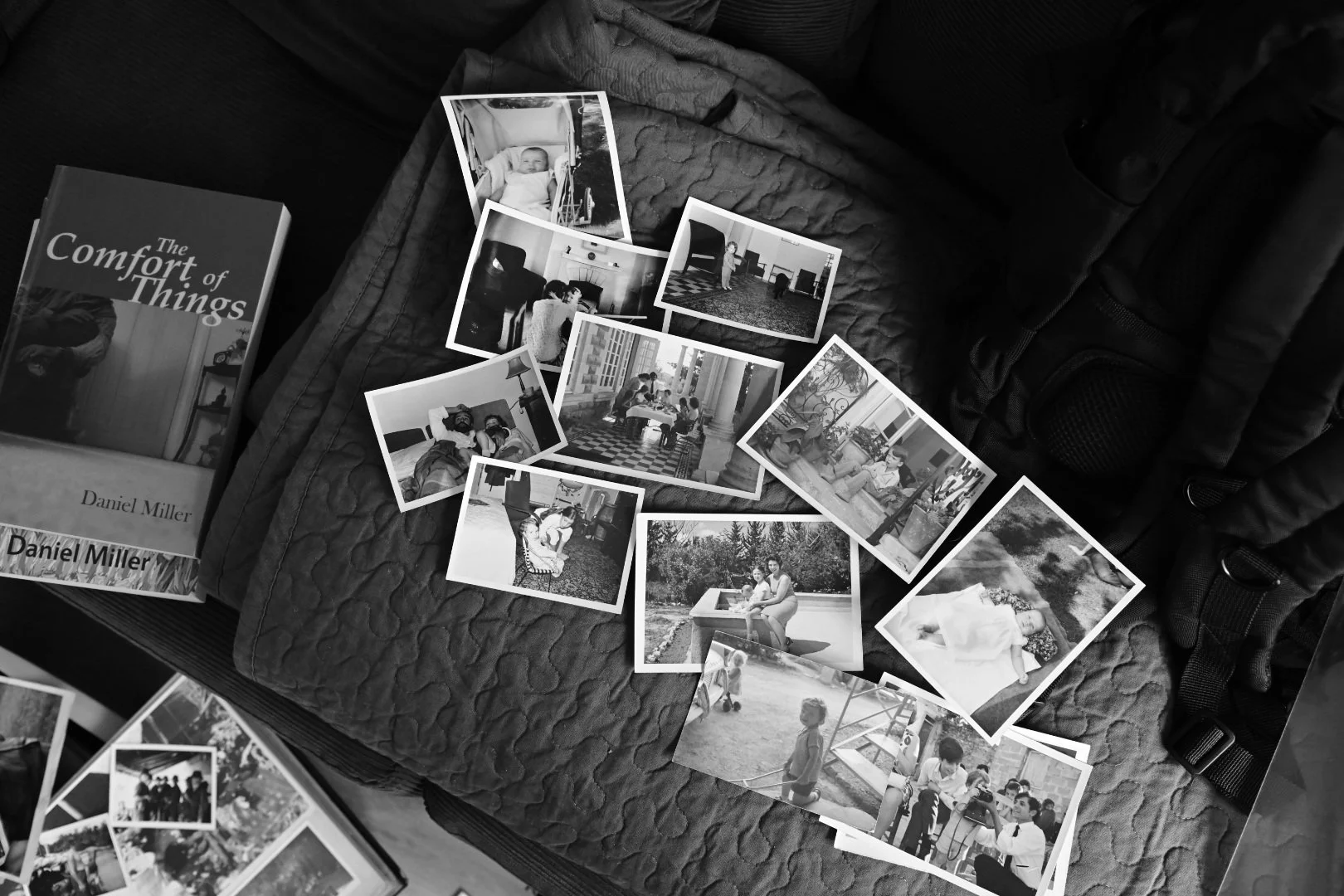
A 10 Minute Conversation
The conversation moved to ethics. I brought it to this, as I wondered how, and if, there had been any issues with subjects perhaps changing their minds about being included in his studies. Professor Miller anonymises his subjects to protect them, which is something he can do fairly easily, but in my world, where I am making photographs, that is not straightforward. He did not have a direct answer to that, but pointed out that there is a problem with focusing entirely on gaining consent, and that it can itself become a barrier to saying anything negative. The point being that too much caution can lead to sanitising the truth of a story. Which made me think that consent to photograph is not just a single event, but something that must be continuously renewed. In my next project, What We Carry, consent may become an ongoing negotiation rather than a signed form.
A few days ago I spoke with Professor Daniel Miller, who is Professor of Anthropology at University College London. I had recently read a book he wrote 15 or so years ago, The Comfort of Things, which I am now using as a reference as I develop my new idea for a photography project: What We Carry.
I loved reading about the different people he had interviewed as part of his research for the book, but there were questions that I had which could not necessarily be answered by the text. Things like his approach to gaining the trust and engagement of the people he met, and access to their personal homes. So, I contacted Professor Miller and he kindly agreed to a "10 minute conversation."
That '10 minutes' gave me a massive download of useful data, and most importantly a perspective that singular thought and consideration alone cannot give. I was quite nervous, if I am honest. It's not every day you meet one of the world's leading voices in the field of anthropology, and even though it was a Zoom call, I had butterflies. I had devised a list of questions, but I knew they might be curtailed by the limitation on time. After a moment of technical issues with cameras and sound, I introduced myself and moved directly to why I had asked him for a quick call. This context was important. I correctly understood that he needed to know he wasn't wasting his time, and I needed to give him something he could engage with. My introduction briefly covered my MA studies, my recent photographic project, the unexpected inheritance of my father's photographs and ashes, and the new project as an offshoot of this experience, which is concerned with our relationship with inherited objects. He listened patiently, and then immediately gave me a list of references suitable for further research, including papers in the Journal of Anthropology by his long-time colleague Fiona Parrott, and other academic writers including Craig Ryder and Sophie Woodward. Once I had noted these references, he moved on to share his thoughts on conducting interviews, and how to get the very best out of those encounters. What he gave me made perfect sense, and although it was not rocket science, it still needed him to say the words for the understanding to land. Be authentic, be genuine, explain why you are talking to them and show that you are interested. They in turn will talk to you. More than that, they will want to talk to you, because you have gained their attention and are showing a focused interest in what they have to say. You still have to convince people, but if you can be honest with them, they will speak to you, or in my case, allow me to photograph them.
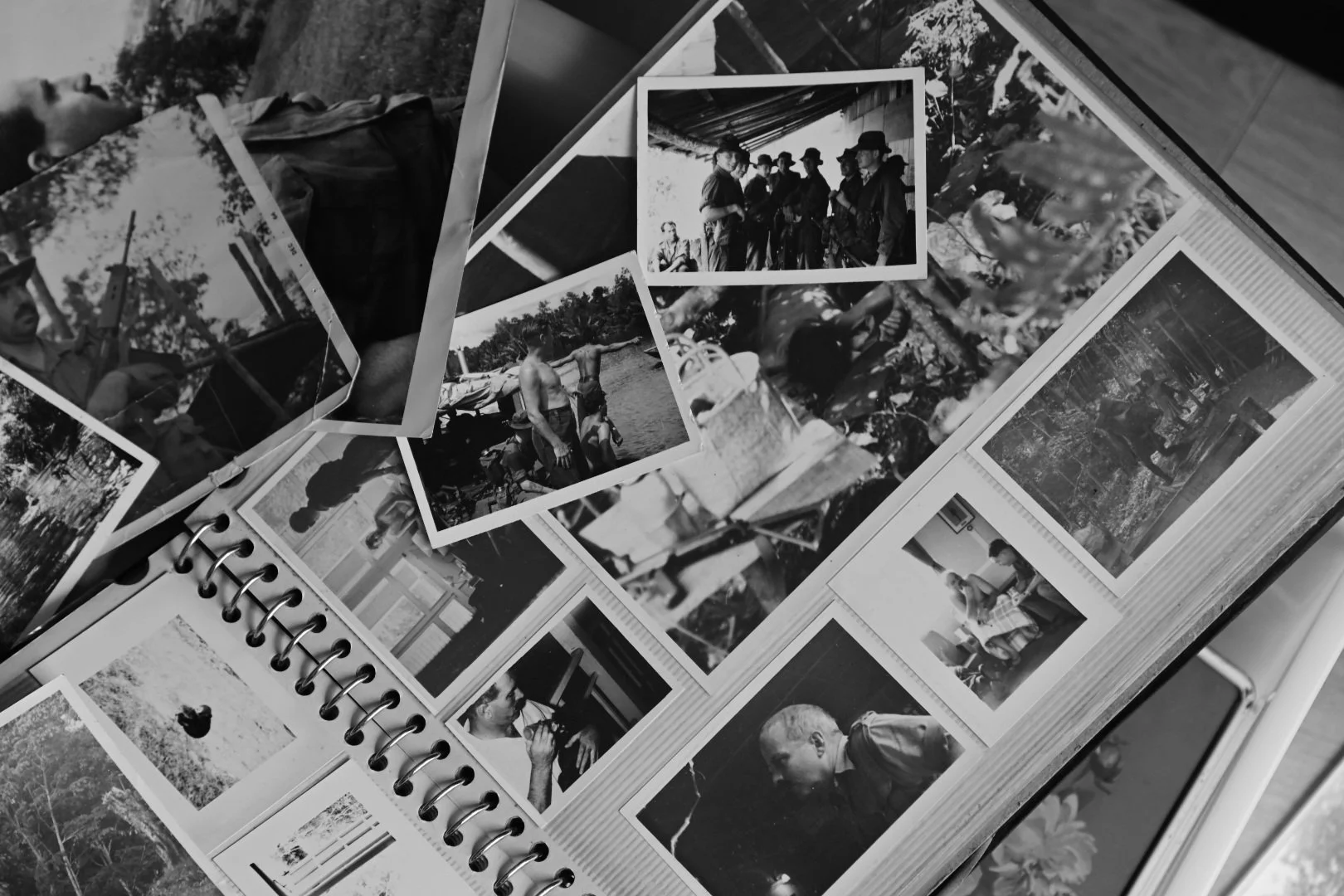
Some of the many inherited photographs that belonged to my father.
I have no idea if he looked at my website, and I didn't ask. This was a powerful conversation and the clock was ticking. Professor Miller spoke about the benefit of conducting research with a colleague, and again this made perfect sense. He explained that some subjects felt more at ease with his colleague, while others were happy to engage directly with him. Sometimes they took it in turns to ask questions, so that the other had time to process and formulate the follow-up. I immediately thought of a book I had read a few years ago, Never Split the Difference by Chris Voss, an ex-FBI hostage negotiator, who always drew on the observations of a listening colleague to gain a wider perspective, one that is not always apparent when you are entirely focused on the conversation itself. He went on to say that it was also beneficial to discuss the encounter with a colleague immediately afterwards, as a way of reviewing the conversation and identifying the most important takeaways. But in my case, I would not have a colleague. I operate on my own, and have no one to bounce off or talk to afterwards. However, perhaps that other person, in my case, is the camera itself. The conversation I have later will be the photographs, and I can see what they say to me. In my last project, the request for the participants' own written words also added that other voice. It allowed the subjects to reflect on their relationship and ask the question of themselves.
The conversation moved to ethics. I brought it to this, as I wondered how, and if, there had been any issues with subjects perhaps changing their minds about being included in his studies. Professor Miller anonymises his subjects to protect them, which is something he can do fairly easily, but in my world, where I am making photographs, that is not straightforward. He did not have a direct answer to that, but pointed out that there is a problem with focusing entirely on gaining consent, and that it can itself become a barrier to saying anything negative. The point being that too much caution can lead to sanitising the truth of a story. Which made me think that consent to photograph is not just a single event, but something that must be continuously renewed. In my next project, What We Carry, consent may become an ongoing negotiation rather than a signed form.
I looked at the clock. It was 12 minutes past the hour, and 2 minutes over our allotted time. I asked if I could follow up with him after I had made a start on the project, thinking he might be interested to see what I had done with the ideas we had discussed. He declined politely, explaining that he had two MA courses to attend to and received approximately 30 requests a day for interviews. I thought: I was fortunate to have had even this brief conversation. And with that, it ended.
© Max McGonigal 2026
Trust and the responsibility that goes with it
And that is really what connects these two questions. My mother cannot consent to what is published about her now; she can only be represented by the choices the rest of us make on her behalf, and trust that we make them with care. Mike, by contrast, consents in advance, not to any specific photograph or line of text, but to me, and to my judgement. Both are forms of the same thing: someone else's story or image, placed in my hands, on the understanding that I will treat it as they would want it treated, even when they are not there to say so themselves.
I was talking to Mike the other day. We had arranged to meet at the end of a weekday, for a quick drink before dinner. We both live a short distance from each other, so we met at a neighbourhood pub.
As we caught up on the week's events, things that had happened to each of us and things coming up to look forward to, we touched on the subject of my mother's diaries and her "life" story, which she wrote in the years leading up to her death. My brother Clive had been in contact to ask if I would be happy for him to publish our mother's memoir on Amazon, as a downloadable Kindle or print-on-demand version. I had only received the email that day, and I was mulling over how I felt about this document potentially being out in the public domain, and whether anyone would really have any inclination to read it. It's been well over ten years since Mum died, so my initial thought was: why now?
Mike listened to me vocalising my internal dialogue about it. What was the point? Who would read it? Was it too personal? It affects myself, Clive and my sister, and also others who are mentioned; should we all consent? Was there an ethical question to consider, even in death?
Mike listened, and said he thought I would figure it out once I'd given it some thought. Even if I decided to put it out there, he trusted that I would only do that if it was the right thing to do.
It made me think of the blog posts I write, and of the photographs I've published on my website. I mentioned this to Mike, and he simply said that because we know each other so well, he completely trusted me with those photographs and that text. If I considered it okay to put it "out there," that was fine by him. He said he felt some sensitivity to it: "It's not something I'd do myself, but I trust you'd only do it if you thought it was okay."
I registered the gravity of that statement immediately. What I had published, on both our behalfs, was deeply personal and deliberate. There was nothing in it that could be considered scandalous or controversial; it was, and remains, personal stories that reference deep emotion and loss. Those are subjects not often spoken about, but I had framed the context for both the photographs and the blog posts, and I believed they were hugely relevant and important, and said much about how we deal with inheritance and loss.
And that is really what connects these two questions. My mother cannot consent to what is published about her now; she can only be represented by the choices the rest of us make on her behalf, and trust that we make them with care. Mike, by contrast, consents in advance, not to any specific photograph or line of text, but to me, and to my judgement. Both are forms of the same thing: someone else's story or image, placed in my hands, on the understanding that I will treat it as they would want it treated, even when they are not there to say so themselves.
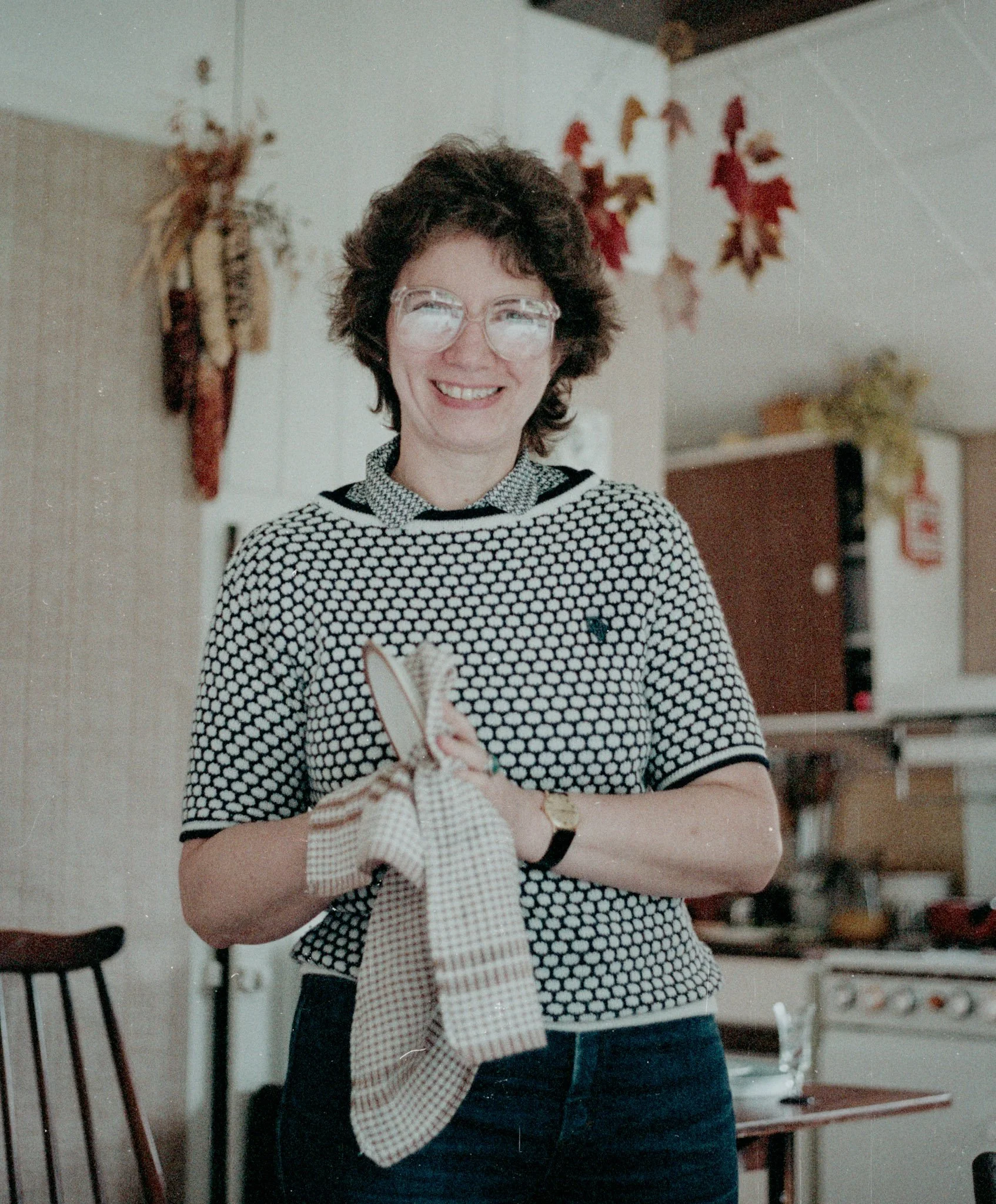
My Mum, circa 1981.
That is what Mike was trusting me with. It is an honour and a privilege, and it underlines something about the ethics of representing people we love, whether they are a friend beside you at the pub or a mother ten years gone. As friends, we look out for each other and protect each other, and he was trusting me to do the right thing. That emotional contract might as well be written in blood. It is that significant.
© Max Mcgonigal 2026
Nightmares, photography, and the meaning of things
I have no recollection of that day, other than vaguely remembering the pool and how deep it was.
Sometime later I had my first nightmare, which I remember clearly. I was being pulled underground into water I had no sense of depth in, calling out for help. That feeling of being alone and scared. It seems likely to have been an after-effect of that day, an unconscious recollection surfacing as fear. So what does this have to do with photography?
Before I went to sleep last night, I was reading Daniel Miller's The Comfort of Things, and had just finished the chapter on Mary and Hugh, two ex-publicans, and the many photographs that adorned their walls. It made me think about the photographs around me, in my own home, the recent additions, and what they represent. They sit in clusters, in different parts of the house, much like the places in my memory. Sometimes those images linger, as do the memories and thoughts attached to them.
That night, I had a nightmare. An awful, terrifying, scream-out-in-your-sleep nightmare. I was being slowly pressed, suffocated by unseen hands and arms that were pushing me into darkness.
I've had nightmares before, but not often, and I don't often scream or shout out, so this one was particularly troubling. I woke in the morning and felt my brain was under a cloud, and I considered what might have caused such a pronounced reaction and so clear a sense of fear and death.
When I was a child in Cyprus, around 5 years of age, I drowned in a swimming pool. The pool was concrete, a deep circular pool with narrow steps that led down to the bottom. On that day, my parents were filling it from a standpipe, an exciting summer prospect for us to play in. I had been left unattended, playing with the water as it gushed into the pool, when I fell in, unknown to anyone. I was floating somewhere near the bottom of the pool when I was found by my brother and sister and my father, who all managed to work together to get me out. My father gave me the kiss of life. My mother had run to the pool soon after, looked at me, my father pumping my chest, and turned away, thinking it was all over.
I have no recollection of that day, other than vaguely remembering the pool and how deep it was.
Sometime later I had my first nightmare, which I remember clearly. I was being pulled underground into water I had no sense of depth in, calling out for help. That feeling of being alone and scared. It seems likely to have been an after-effect of that day, an unconscious recollection surfacing as fear. So what does this have to do with photography?
Well, that sense of who we are, and our place in the world we inhabit, is largely shaped by the environment we live in: our home, and our connection to the past, with relatives, friends, places, all most commonly represented by the photographs we put on the mantlepiece, or the wall, or the bedside table. These photographs give us a sense of our past, and what got us to this present moment. They are reassuring, but ultimately represent the fragile nature of time and the inescapable march of it. They remind us all that we are here, for now, but we won't be forever. Photographs of relatives who have passed away are the clearest indication of this, as those moments give us reason to think of them, even fleetingly.
I recently was given two boxes of photographs that were my late father's, salvaged from a house clearance. I didn't expect them, as it had been over 5 years since my father passed away. Along with the photographs was an old pickle jar, with the remains of his ashes in them. Again, I did not expect that, as I had assumed his ashes had been scattered. The background to what happened after he was cremated is not really important now, so I won't go down that road; however, the fact that his ashes were now back in my possession, alongside all these photographs, gave me pause to think about the past, and forced me to consider this collection and what I should do with it.
Initially I went slowly through the photographs, lingering on some, shuffling quickly through others. All of them meant different things to me, but all of them reminded me that I won't be here at some point, and what will others do with all the photographs that I take, or have taken? Will they preserve some and throw away the vast majority? What will those photographs that mean something to me, mean to others? Are they important or not? Perhaps they will sort them into batches and put them through the letterboxes of unsuspecting friends and relatives, and see what they do with them. I found that thought quite intriguing. I reflected on Roland Barthes and his book Camera Lucida. That sense of punctum seemed to run through the whole unexpected collection, and through my own thinking about the photographs I've taken.
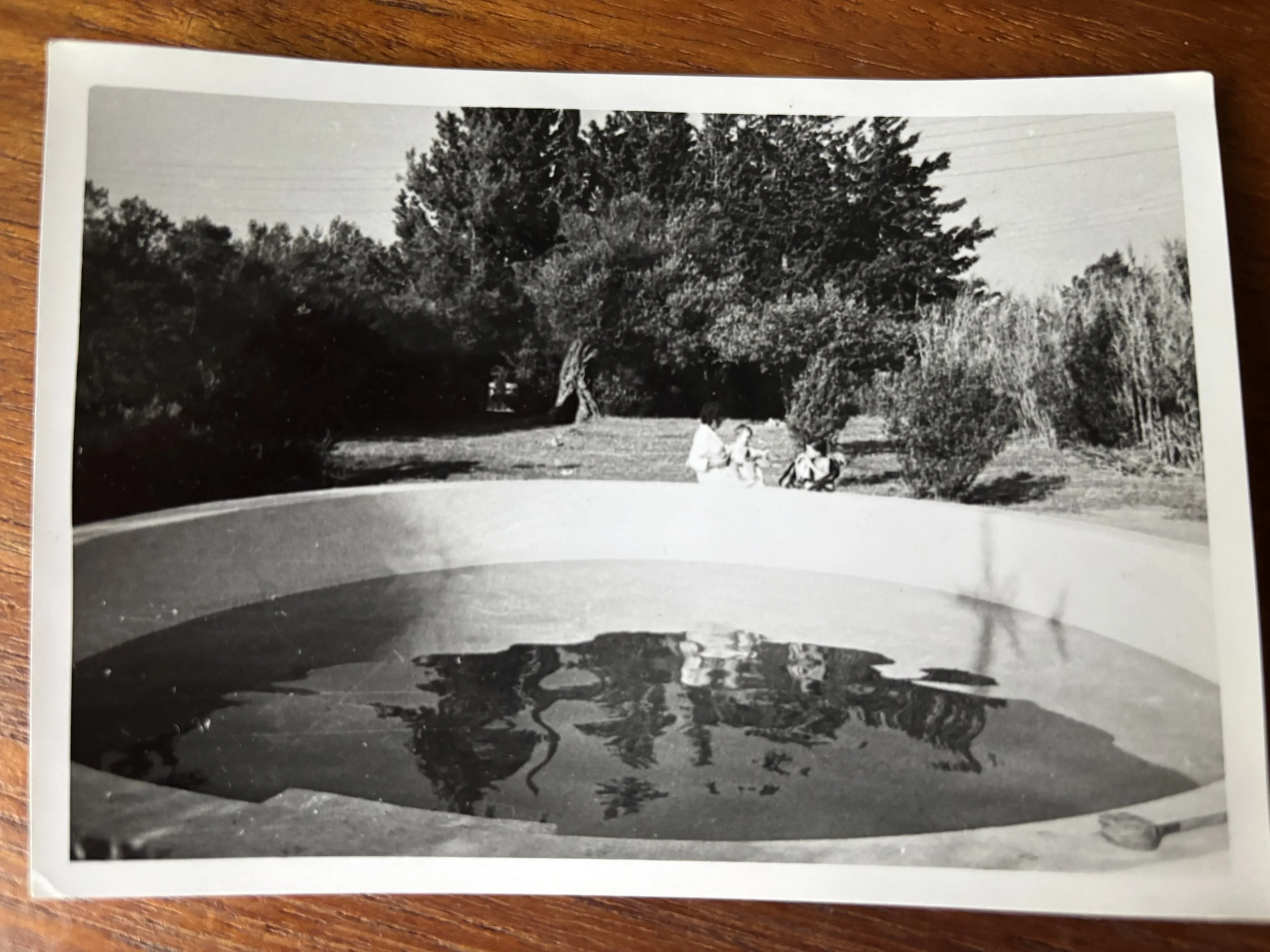
The Pool, 1968. Approximately 3 years before I drowned in it.
Then, in among those same photographs, was a photo of that concrete pool! The pool I drowned in, and most likely the reason I experienced my first nightmare. What did this photograph say about me and that time, and what does it still mean? My father had probably looked at this photograph at some point, and thought back on his own memory of that event and the outcome of my survival. It could have been very different. This photograph could have been all that was left of a place where he'd lost a son, but instead it was just a photograph of a pool which means nothing really, to anyone else.
It's been about 15 or 16 years since Daniel Miller first published The Comfort of Things, so reflecting on Mary and Hugh's story, it may well be that this chapter is now something of an epitaph to them, assuming perhaps one or both have died in the years since Miller wrote the book. If that's the case, I wonder what happened to all their many photographs. Did relatives sort through them, keep some, dispose of others? They had no children of their own, so perhaps most or all were thrown away; many of the photos were of places and people they'd met during their publican years, and would simply mean nothing to anyone else. There was one photograph among my father's that I instinctively knew wasn't his: a photo of someone else's children, a happy image, but of no one I think my father knew. It was perhaps a photograph of another family entirely that had somehow crept into this collection I'd assumed was purely my own. It meant nothing to me, but must mean something to someone else. I considered throwing it away, then salvaged it from the bin. It felt wrong to do so. Such are the hard choices. Perhaps I was too closely reflecting on my own memories through these photographs to feel comfortable throwing this random one away. Perhaps the idea of my own photographs, batched together and dropped through the letterboxes of friends and family, isn't such a bad one after all; it would push this dilemma onto someone else, better placed to make the call.
In the meantime, these photographs from my father are still with me, even the random one. I still don't know how to navigate this delayed "gift." As I continue to develop My Father, My Son, it will likely become clearer. I have some ideas too around inheritance, legacy, and family photographs, a new project, What We Carry. Perhaps that will be the answer. Let's see.
Max McGonigal © 2026
What’s left?
I asked Mike for a few words on what this photo, this object, this connection to the past, meant to him. “Photo Booth. Father Roy, clean shaved, suit and tie. Sister Katherine, chocolate mouth. Frozen here, both long gone and time moved on.” He also described it simply as “Green lament,” a play on his family name. His words came out lyrical, which felt right, given how much of his life has been shaped by listening to and making music.
On the 21st June I went to the Brixton Windmill to see some live music, and met up with Mike, Danny, and Pat. We'd had the evening planned for a couple of months, and despite it being a Monday (a "school night"), it was great to get out and see the old crowd. We go back a long way, having known each other since college and university days. Over the last 30 years we've met up on many occasions to see all sorts of varied, alternative, avant garde music (some of it good, some of it not so good), and we also made music together during Mike's most creative era, back in the 90s. Pat, myself, Danny and Mike made two albums' worth of tracks, which Danny has kept and shared with us (he's the archivist). We talked about it in the Whitehorse pub before walking round the corner to the Windmill, reminiscing and laughing at the strange things we once recorded together.
So what does any of this have to do with the day I went to photograph Mike's story?
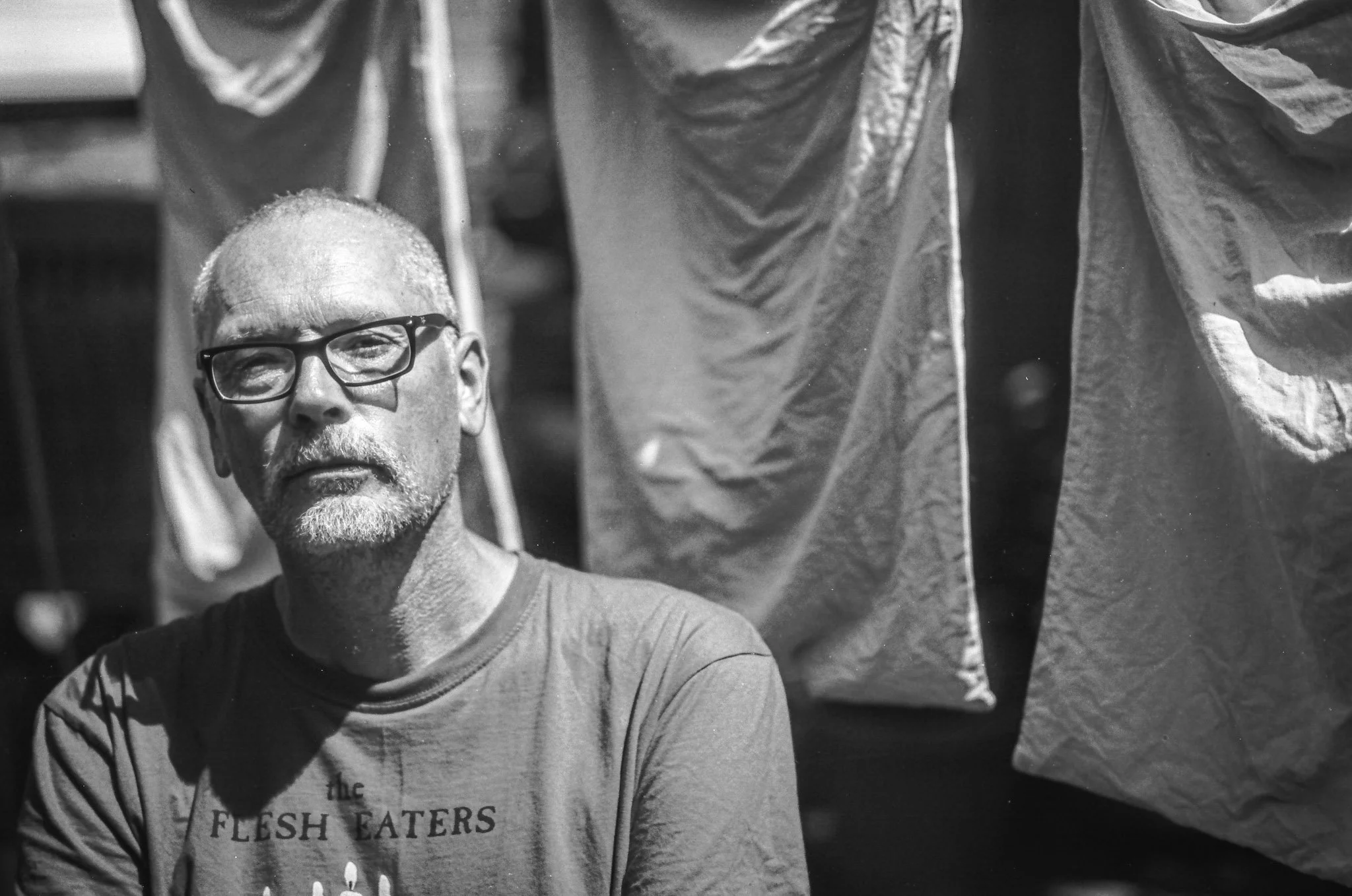
Well, mine and Mike's lives are parts of a larger jigsaw puzzle. Each piece only goes in one way, one space, and connects to other stories, people, places, and time. Mike's piece connects to my own, and we first fitted them together in Streatham, as teenagers, starting out at college and discovering our first taste of independence. We hung out a lot back then, listening to music or whatever else filled the evenings. Mike's home in Leithcote Gardens was close to my own, and I'd met his father a couple of times when visiting, though I knew very little about him or the circumstances of their family life. Like my own, his father-son relationship was fragmented, and something you didn't talk about as teenagers. We've lived close by, either in the same neighbourhood or borough, for the best part of 40 years. Largely coincidental, but fortunate too, since it's kept us in at least irregular contact with each other.
Since I divorced, we've probably lived closer to each other than ever before, just two or three streets apart. For a while it was a lifeline, and we saw each other far more regularly. I think we share a quiet appreciation of each other's company, and a distinctly absurd sense of humour, which has genuinely been one of the steadiest anchor points between us. A mutual love of music has also meant we keep going to see both good and bad gigs, always with the expectation that we'll come away with something worth holding onto.
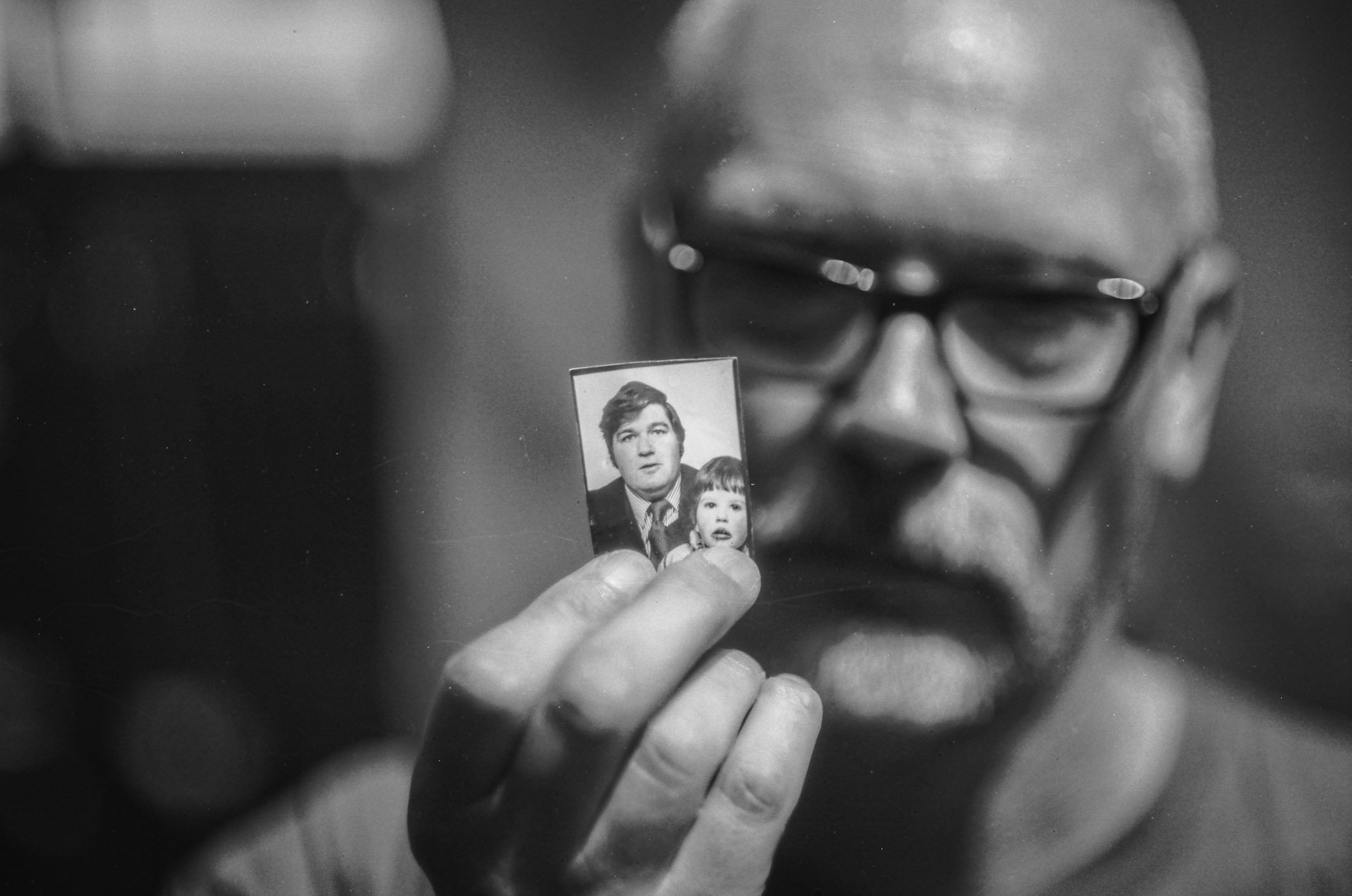
Mike has followed my progress on the photographic project since its inception and has always been encouraging, so I felt I could ask him to be part of it, given that his own father-son relationship, like my own, was shaped by absence. His father Roy died in the 1990s. Mike has few mementos from that time, apart from a photobooth strip of Roy with Mike's older sister Katherine, who died as a child. The photo was taken in the seventies: a toddler with a chocolate-smeared mouth sitting on her father's knee, both of them a little startled by the flash. Two people on a day out, caught in an ordinary, indexical family moment.
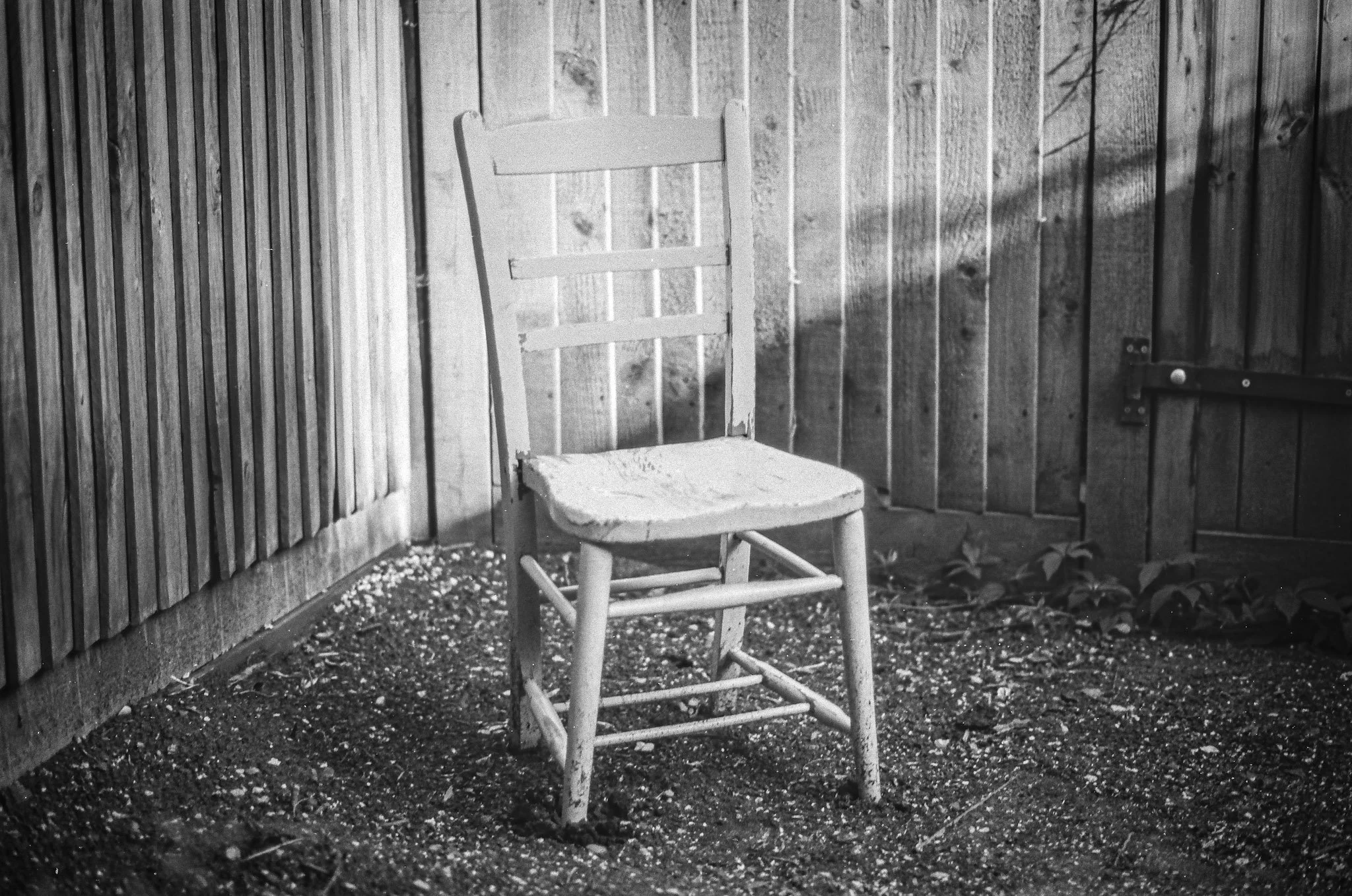
I asked Mike if he'd be one of the subjects for the project, and whether there was something he might want to include, something inherited that carried meaning for him. He has very few of his father's possessions, and this photo strip may be the one thing that does. When he went to fetch it, I wasn't sure what to expect, or whether it would fit the brief I'd set myself. I hadn't seen it before, and my first thought was: if it's very small, how do I shoot it so it doesn't disappear in the wider frame? But when he came back and I looked at it, and at him (he's very tall), the contrast in scale between the small photo and his physical size felt right. I held it for a moment, handed it back, and said it would work. I sometimes look at the obvious and assume it won't. We took a couple of test shots on his stairs that evening, then repeated the shoot a few weeks later, in his garden, in the sun. Mike sat against a brick wall, and I shot as we made small talk about the heat, the gig from a week or two before, Danny, Pat, and other things I don't recall now. We moved to a small wooden chair at the back of the garden. It seemed to be waiting for an occupant, and Mike's scale worked well there too, partly because there were three people in the frame: Mike, his father, and his sister. I hadn't anticipated that, but I saw immediately how it sharpened the sense of loss in this particular relationship.
The earlier test photos, of Mike and the photo strip on his staircase, convinced me the elements worked together as I'd hoped. This time I asked Mike if we could repeat the shoot, but in the back garden, a small urban space he shares with his partner Juliet: a decked area, high boundary fences for privacy, potted plants and small trees giving it a relaxed, sheltered feel. It suited the shoot well as a neutral, available space. Following on from the Gateshead shoot with Joe and Alex, I'd decided that continuing on 120 black and white, using my father's Yashica 124G, alongside digital, would be the right combination. On the day, though, I decided to also shoot 35mm neg, so I brought the Nikon F100 with Tri-X, FortePan 400, and the Lomo Babylon that had been sitting past its expiry date at the back of the fridge. Everything was developed and scanned by Stuck in Film in Croydon, who've done a consistently good job with a growing pile of my negatives. It was hot and sticky. I started with the 120, a roll of FP4, against the brick wall. The depth of field was wide, since the sun gave me no other option and I had no ND filters with me. My first reaction to the expanse of brick wall was that it felt too busy, too distracting. But there are always other ways to look at it, and I've learned my own way of dealing with what feels, at first, like an error: look again, work out what exactly is bothering me, and widen the view. The other shots, the 35mm, the other setups, might counterbalance what I'd read as a mistake.
The shoot ended up spread across two dates, about a week apart, again down to a habit of mine: shooting too close, too soon, chasing detail before I've found the foundational frame. Harry Borden had once told me he preferred my wider group shots from an earlier My Father, My Son session, the ones that gave the subject environmental context. I understood exactly what he meant, and it was obvious I needed that same contextual framing here, to let the story unfold the way I wanted. So I went back later that week and reshot some 120 with a wider frame, against that same busy wall, and it started to feel like a set rather than a single image: the empty chair, Mike against the wall wiping the sweat from his head, the narrow depth of field from the ISO 12 Lomo film on the F100, and the photobooth strip anchoring it all.
This was the shoot that connected with me most personally, because I found my own story inside it too: my father, the camera he passed on to me, and the mixed feelings of inheriting objects and trying to work out what they mean. Mike's story was more complex than mine. His sister was the third point in the triangle, and perhaps she was the punctum that cut deepest, a life and a relationship that was missing, a private loss known only to Mike and his family. I felt trusted, let in on something. Walking home afterwards, I found myself thinking about the weight memories carry, and what they hold for each of us.
I asked Mike for a few words on what this photo, this object, this connection to the past, meant to him. "Photo Booth. Father Roy, clean shaved, suit and tie. Sister Katherine, chocolate mouth. Frozen here, both long gone and time moved on." He also described it simply as "Green lament," a play on his family name. His words came out lyrical, which felt right, given how much of his life has been shaped by listening to and making music.
Max McGonigal © 2026
Where This Began
When I was nine years old, my father had a conversation with my mother in the living room. It was past bedtime, and I was supposed to be asleep, but that evening felt different. I crept along the corridor in my pyjamas and lay down, resting my chin on the carpet, watching through the slightly open door. My father told my mother he would not be living with us anymore. My mother made a sound I had never heard before. My heart felt like it was burning a hole through the carpet.
When I was nine years old, my father had a conversation with my mother in the living room. It was past bedtime, and I was supposed to be asleep, but that evening felt different. I crept along the corridor in my pyjamas and lay down, resting my chin on the carpet, watching through the slightly open door. My father told my mother he would not be living with us anymore. My mother made a sound I had never heard before. My heart felt like it was burning a hole through the carpet.
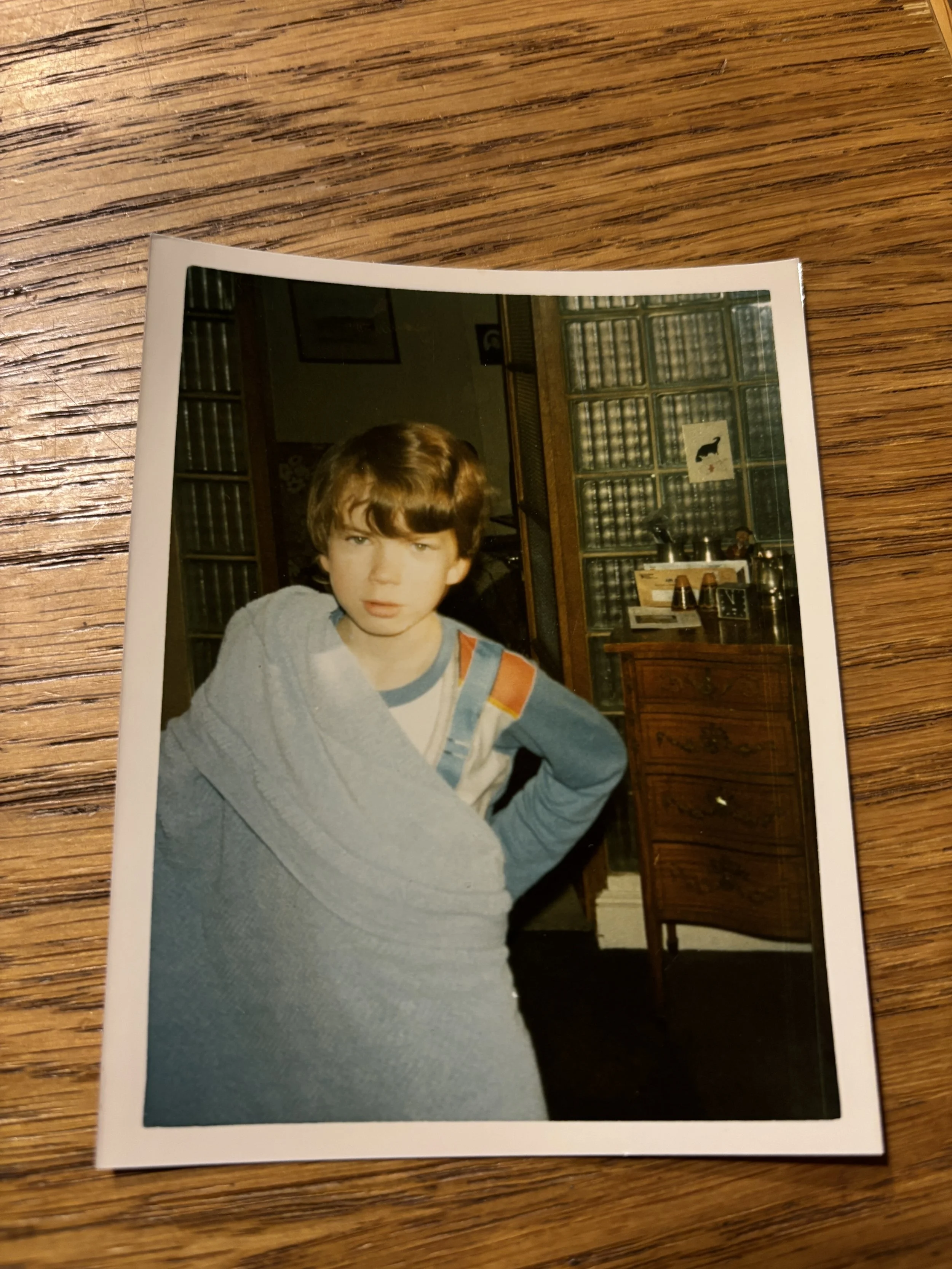
Me, age 9 or 10, around the time my parents split up
Our relationship was shaped by that moment. Afterwards, he became an occasional visitor rather than a constant presence, someone I met in restaurants and hotel bars, our time together bound up with whatever the occasion allowed. Sometimes those meetings were marked with a photograph: me, him, that place, that particular afternoon. I did not understand what I had witnessed on the carpet that night, not then. But I began, slowly, to use photography as a way of trying to make sense of it.
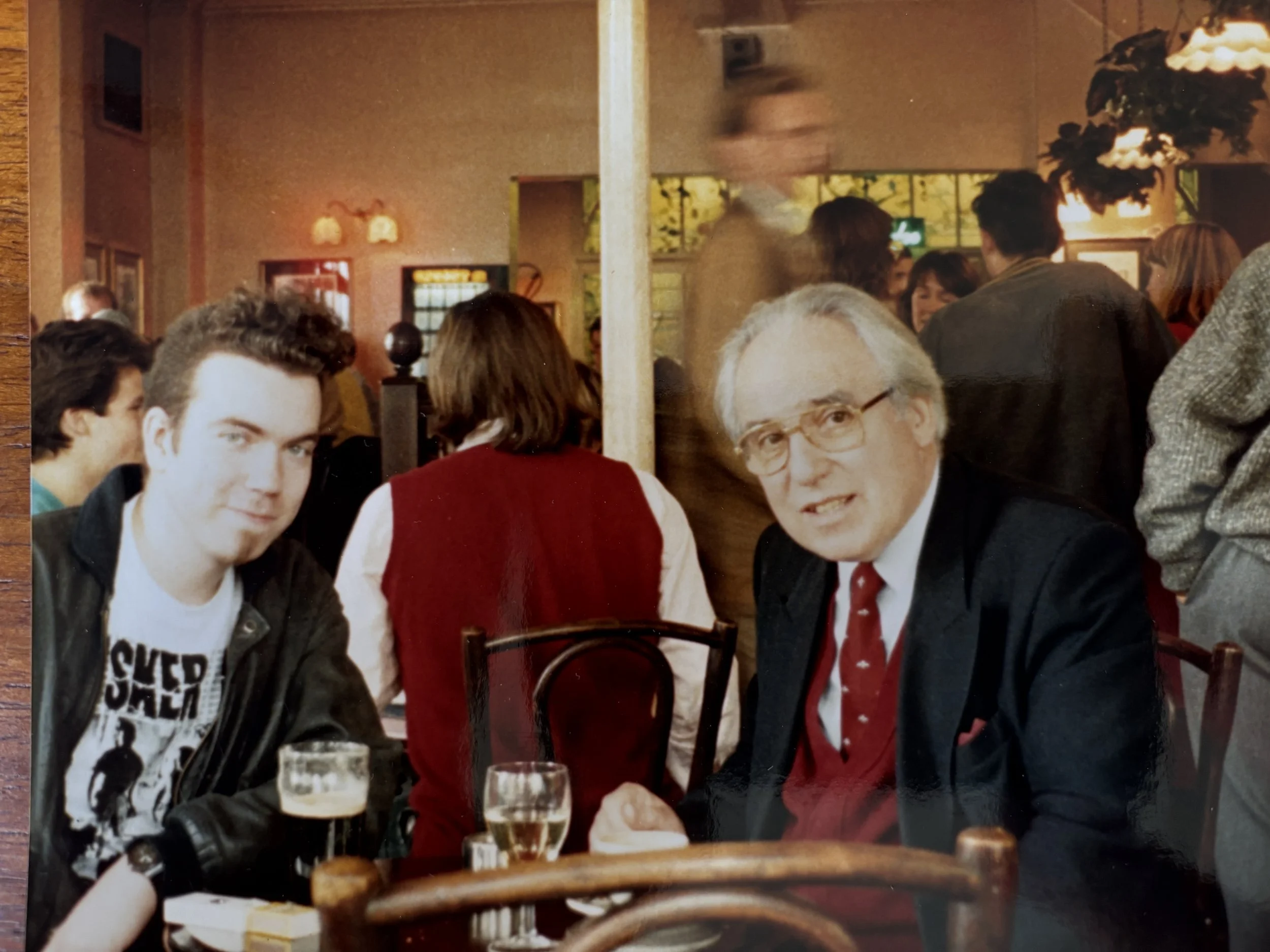
Me and my father, circa 1989
I came to photography the long way round. Years of looking, taking photos, looking at them again, thinking about what they meant to me, before I began to study them seriously. I find myself drawn to questions about what portraits really do, and what they reveal about the people who make them as much as the people they picture.
That question, of what a photograph reveals about the person holding the camera, sits at the centre of my current project, My Father, My Son. It is a long-term study of father-son relationships through portraiture and sequence, part of a tradition of photographers who have turned the camera on their own families. It asks what happens when images accumulate over time: how a single portrait becomes testimony, and how a series becomes something closer to truth. It is, in part, an autobiographical project. Which is to say, it is also about my family, my own father, and the particular silences that pass between men across generations.
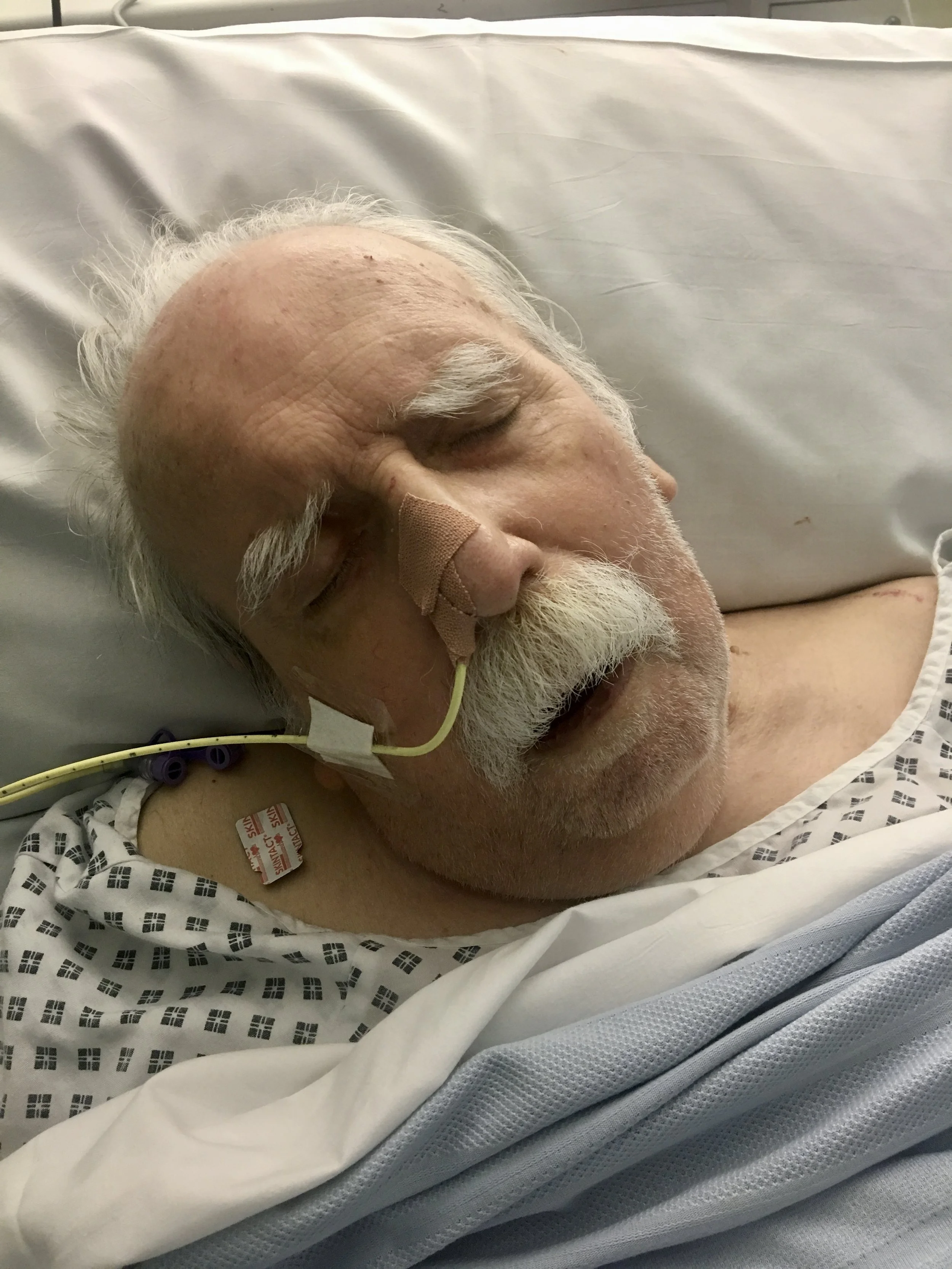
My father, UCH, 2018
Working on this project has taught me something I did not expect when I began. The moment on the carpet taught me that you can witness something completely and still not understand it. Photography, I have come to believe, is not the resolution of that gap, but its honest acknowledgement. Each portrait I make, each testimony a subject offers alongside it, adds to an accumulating record that does not claim to explain a relationship so much as bear witness to it. That, perhaps, is what a series does that a single image cannot: it replaces the false certainty of one photograph with the more truthful condition of an ongoing search.
Max McGonigal © 2026
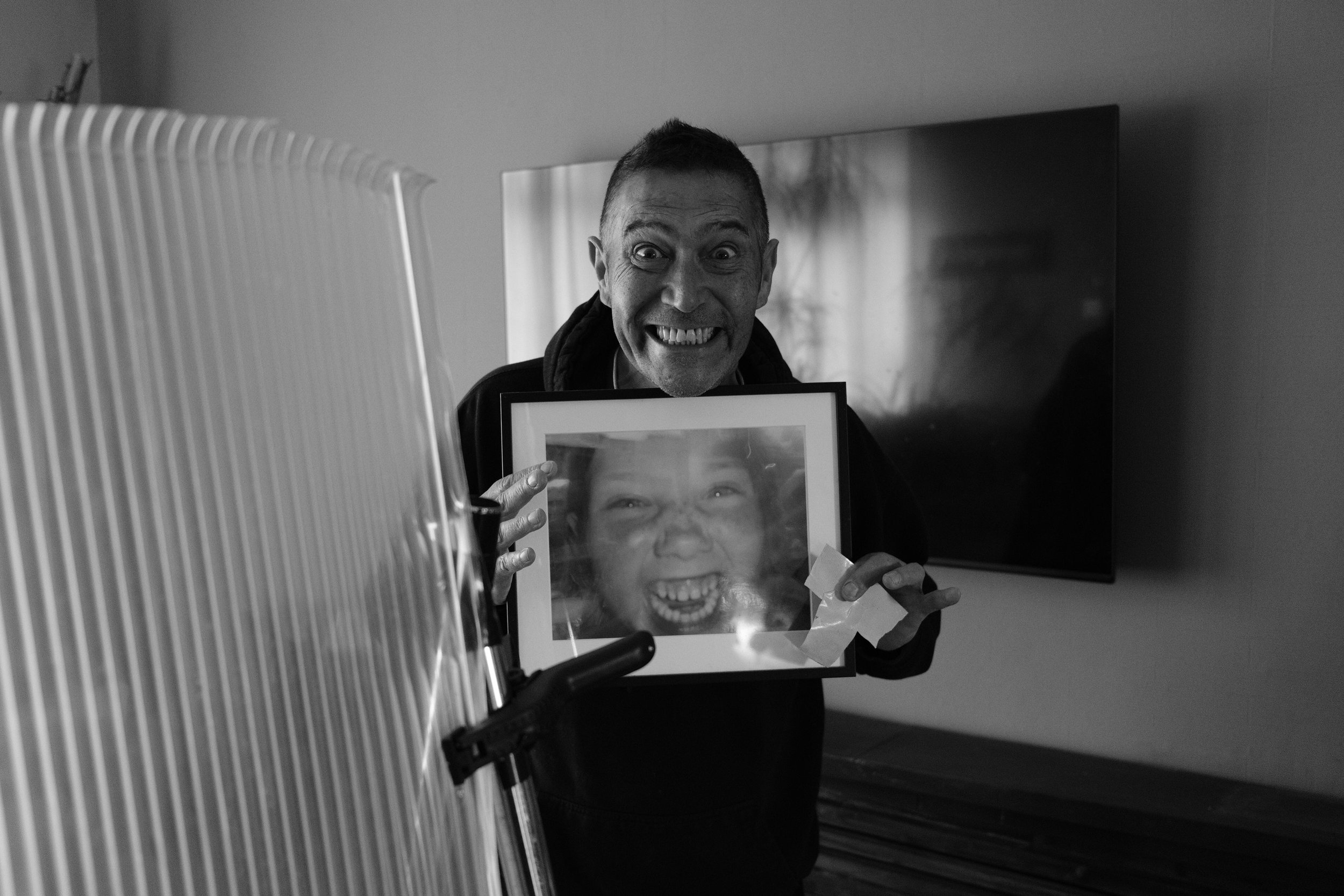
A short film and a portrait opportunity
The journey up to Newcastle, by LNER, was rather nice. I'd upgraded to first class, not much more expensive than standard, anticipating I'd be short of time to eat after a full day's work, the perk being snacks, drinks, and a light meal. The other perk was the aircon. It was a bloody hot day, and by the time I reached King's Cross I was knackered, with a proper sweat on. I'd packed a few cameras for the journey, having already spoken to Joe about the possibility of a portrait shoot with him and Alex. The film we'd been shooting was about identity; I wanted the portraits to sit in that same space, since Joe and Alex's family journey (Alex was born female, and now identifies as male) is its own unfolding story of identity, just as much as the one on screen.
Joe and Alex — My Father, My Son portrait shoot
I have been busy recently. Between my full-time work, studies in the evening, and arranging either social activities or photographic opportunities, it's been quite hectic. I am NOT a natural multi-tasker. I'm more linear... perhaps analogue in my approach. I make a list of sorts and work through tasks in no particular order, though that's not the case for my professional life, where I prioritise by business imperative. When it comes to stuff for myself, it's a little more random, but there's always a list, and checking things off as I go is a dynamite feeling.
Last weekend was a trip to Nottingham, for a music festival. This weekend was a trip to Gateshead, to complete a short film for my friend Joe. A little different, but no less special, since this one carried some real weight. Joe has been a friend since the early 90s, so we understand each other well, and how we each 'tick' when it comes to the creative process. The film he's making is co-written with his son Alex, who also plays the lead. Alex is trans, and the script is a fictional exploration of that journey. I agreed to come up and help with the filming, as I've done that kind of work before and I still love the camera side of production. But this trip was also going to give me the chance to photograph Joe and Alex together for My Father My Son, the project I started a few months ago. That's really what this weekend was about for me.
The journey up to Newcastle, by LNER, was rather nice. I'd upgraded to first class, not much more expensive than standard, anticipating I'd be short of time to eat after a full day's work, the perk being snacks, drinks, and a light meal. The other perk was the aircon. It was a bloody hot day, and by the time I reached King's Cross I was knackered, with a proper sweat on. I'd packed a few cameras for the journey, having already spoken to Joe about the possibility of a portrait shoot with him and Alex. The film we'd been shooting was about identity; I wanted the portraits to sit in that same space, since Joe and Alex's family journey (Alex was born female, and now identifies as male) is its own unfolding story of identity, just as much as the one on screen.
For the portraits, I brought my late father's Yashica medium format camera. It's become a personal thread connecting my own father-son relationship to this project, and I know he'd have been glad to see it used this way. Alongside the Yashica, I brought a Nikon F100 and a Fuji X100VI. I'd decided, mostly on instinct, that the shoot would be covered largely in black and white film, saving the X100 for background images only. Black and white felt right for this; stripped of colour, it seemed closer to the honesty I wanted the portraits to hold. I'd also brought my notepad, for the journaling habit I'm still trying to properly stick to.
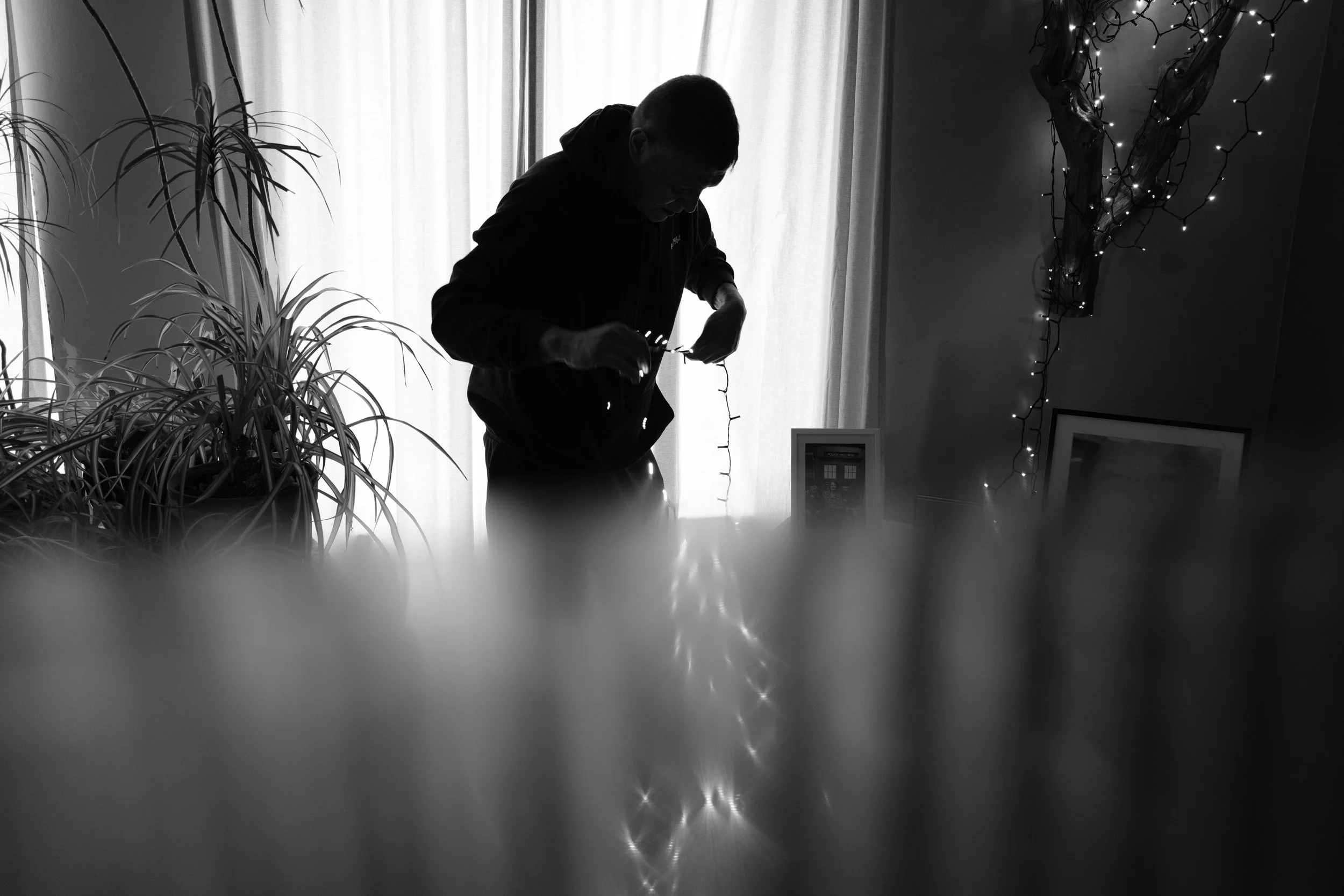
Joe, untangling some lights on the Brechtian set.
Filming for 'Cal', the name of the short, was entirely indoors this time, on an improvised set. The approach is stripped back and Brechtian, which meant we could worry less about the appearance of objects and what they denote, and more about feeling and connotation. I wasn't sure what to expect going in, but it started to make sense once we were underway. Joe's Lumix S5II is a fantastic bit of kit; I'd used it once before, last year, and we'd saved the user settings we needed to stick to. Good thing too, since it had been six months or more since the last shoot, and I needed a little time to find my feet again. The main things to hold onto were a 180-degree shutter angle, shooting V-Log, and exposing correctly or up to a stop over. All handheld, so my arms and my knees did all the work.
The natural light in the house was excellent, and filming went well on Friday. Saturday afternoon gave us the chance to grab some portraits of Alex and Joe. I'd had my eye on two mirrors in the house, thinking they might frame one of them well. The light was a little darker than I'd have liked, so I used a step ladder to steady myself and the Yashica, and took twelve exposures before switching to the 35mm Nikon. Both cameras were loaded with Tri-X. I came away with a feeling that, if the film develops cleanly and there isn't too much camera shake, these could be a strong addition to the project. Later that afternoon I shot another roll of twelve (this time Washi “K” expired aerographic film), just of Joe, then switched to the X100 for some photographs of Joe's cat, which I properly enjoyed. Rasha as he's called, is a lovely black cat, and rather photogenic himself.
Once I was home, I asked Joe and Alex to write something for the project, in their own words, about their relationship. I always ask this of the people I photograph. It's the part of the work that matters most to me, giving the subject the space to speak for themselves rather than having me speak for them.
Alex wrote about what it means to be accepted without condition. He described his dad as an extremely accepting man who loves him for who he is, someone who has always cared about his pronouns, his expression, and how he looks after himself while going through the transition. Alex said his dad never tried to hold onto a cisgender father-son relationship once he came out, and instead adapted, so the relationship could suit them both as the people they'd become. 'I couldn't wish for a better dad,' he wrote. 'It's so perfect.'
Joe's statement went somewhere I wasn't expecting. He wrote about having three sons, though his first was born male and the other two were born female. He was honest about the difficulty of that shift, admitting that calling himself fluid enough to simply accept it would be a lie, and that he floundered before he found his way through. What moved me most was what he said Alex had taught him: to see through their eyes, especially before transition, to understand the fear of stepping outside into a world that sees you as the opposite of who you are. 'He taught me to see the human and not the sex,' Joe wrote. 'To see the person, without preconception. To see, just them.'
The evening ended with a few beers, a home-cooked Thai curry, and a film, Bugonia, which is completely mad but bloody brilliant. What made the weekend special was, in many ways, its uneventfulness. I went to Gateshead, saw an old friend, took some pictures of him and his son, and came home.
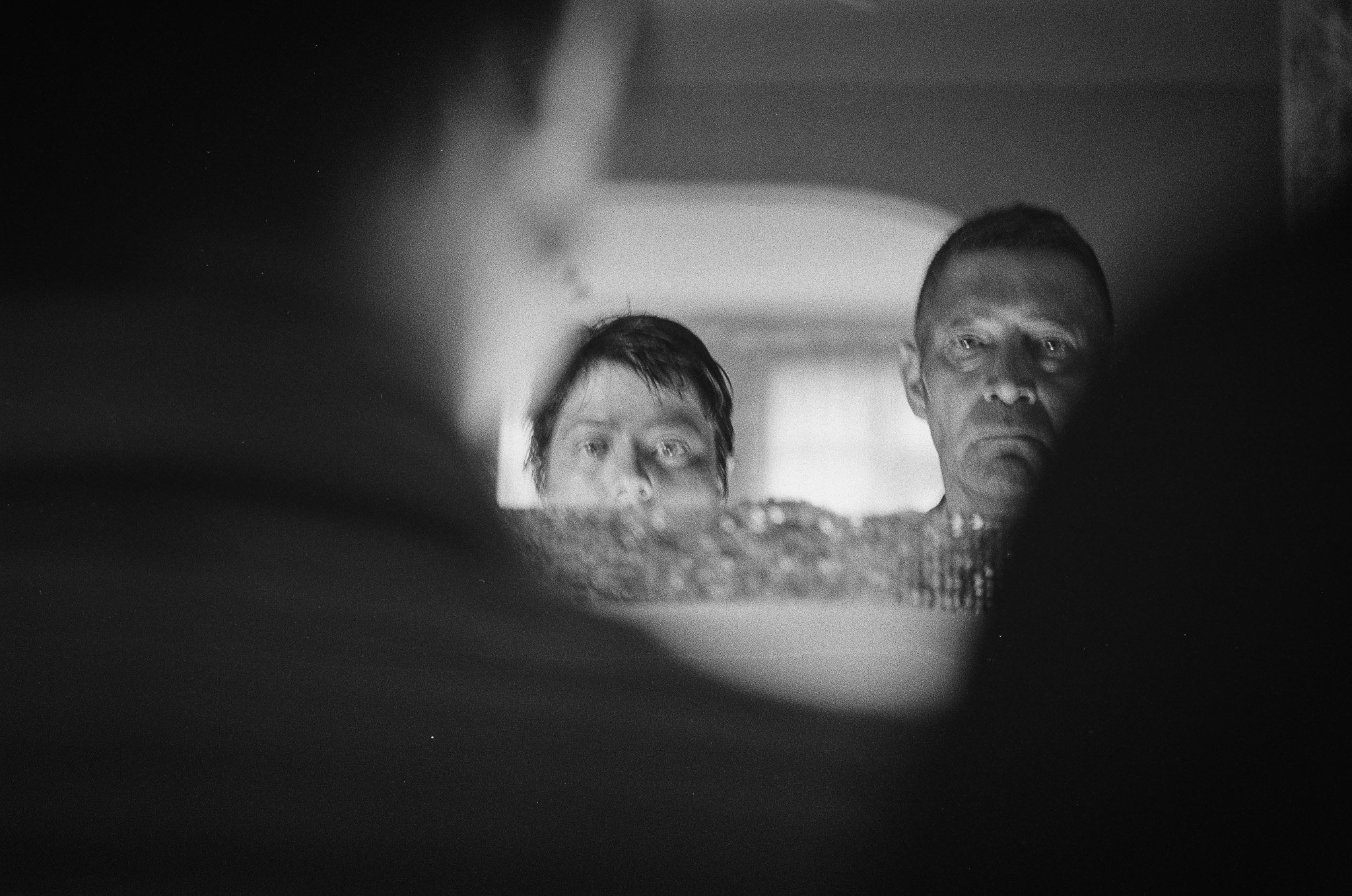
Alex and Joe, in one of those mirrors I mentioned.
But underneath that simplicity, something else happened. I reconnected with a friend I've known most of my life. I witnessed quiet, intimate moments between a father and his trans son. And I understood, a little more deeply, just how unique every family relationship I photograph really is.
It made me think of Dad.
Max McGonigal © 2026
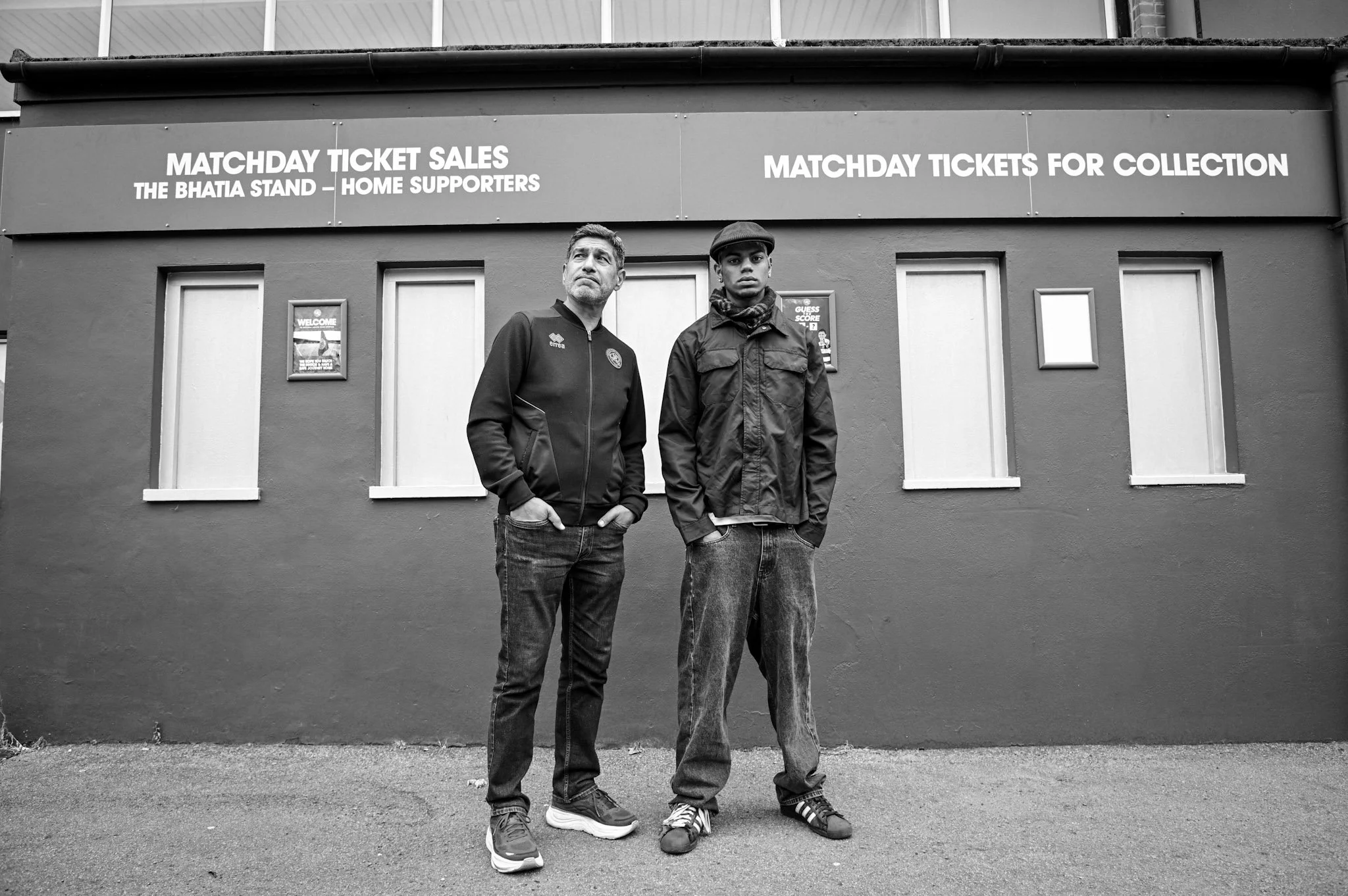
Murli and Kundan @ QPR
Together, the two statements describe the same relationship from opposite ends of it. Murli wrote about watching Kundan become who Murli once was. Kundan wrote about being made by his father. For Murli, QPR has functioned since boyhood as what we might call a holding environment; a stable structure through which identity and community could be felt before they could be named. Belonging was absorbed, not chosen. And now, watching his son build his own friendships through the same rituals, the same colours, the same turnstiles, he sees his own formation reflected back across a generation.
Murli and Kundan — My Father, My Son portrait shoot
I have been working on the My Father, My Son photographic project for about four months, slowly building the foundations of something very close to my heart. These are not simply portraits. They are negotiations between presence and absence, between what is spoken and what is carried silently. The project continues to grow as I find new subjects, new stories, and new ways of understanding what it means to be a father, to be a son, and to navigate the space between.
I approached Murli and his son Kundan to see if they would be interested in participating. I have known them for about ten years, and we could be described as camping friends; we are part of a larger group of families in the Ealing area who used to go camping together at least once or twice a year. We have shared conversation and laughter while building tents, flipping burgers, or drinking beer around a firepit in the evening, but we had never connected creatively in this way. Certainly not in any way that would require a deep self-reflection on what it is to have a father-son relationship, and what unique story it holds for each of them.
Murli is a similar age to me (late fifties) and Kundan is, I think, eighteen now. Their mutual love for QPR became the natural backdrop for the shoot. When I asked if there was anywhere in particular they wanted their portraits taken - somewhere with shared meaning - Murli immediately said Loftus Road. It made sense: he has been a season ticket holder for years and grew up in the area. We exchanged a few WhatsApp messages and the arrangements largely took care of themselves. We met on South Africa Road, outside the main ticket entrance, on a quiet Sunday lunchtime.
I arrived early, as I always do, and took a couple of frames of the location in anticipation of the light, hoping for a little late inspiration as to a useful spot for a backdrop. The area itself borders a 1930s estate on the north side of the road, and the stadium side is not overly interesting - neither architecturally distinctive nor brutalist in any compelling way. It is, I suppose, exactly what you would expect an urban, inner-London football ground to look like. I was a little anxious that it might not be as useful a location as I had imagined, but I put those feelings to one side. I was more concerned about meeting them and figuring out the best approach to the photographs - what I would say, how I would direct them. I am, at heart, quite an awkward person when it comes to communication, which probably explains why I prefer being behind the camera and observing. This kind of work does, however, require directing your subjects and giving them enough feedback that they understand what you are trying to achieve.
By the time Murli and Kundan arrived I had overthought it several times over and was quite nervous. Kundan admitted he found it the most awkward too, and preferred not to remove his jacket; they had arrived wearing the QPR home strip underneath. I said I honestly didn't mind, and that it was important we all felt as comfortable as possible. I went into waffle mode and for the most part can't remember much of what I said, but it must have been fine, because Murli and Kundan seemed to immediately get it. We spent about twenty to twenty-five minutes in a ten-yard stretch outside the stadium, working through a few different set-ups using my digital Nikon D780 with a 50mm lens. I then put it away and pulled out my dad's old Yashica 124G medium format camera, loaded with a roll of Ektachrome. I worked more slowly with it (it takes a little time to focus and line up a shot), and it was at this point that the questions started rattling around: had I taken enough? Were the set-ups different enough from one another? Was this story, in itself, distinct enough to stand among the others?
I took a deep breath when I reached the final frame on the Ektachrome roll and announced we were done. Murli and Kundan offered to drive me home, which I gratefully accepted, and we made small talk about the club - how often they came, the friendship groups they both had and shared. It added more context to their story.
When I looked at the digital images at home, they were better than I had expected. It wasn't so much the location itself, but how Murli and Kundan were within it: at ease, in familiar territory, in a place they felt at home. I sent the Ektachrome roll off to Stuck in Film in Croydon, a film and scanning company I have grown to trust enormously. They are extremely good and reliable, and I would thoroughly recommend them.
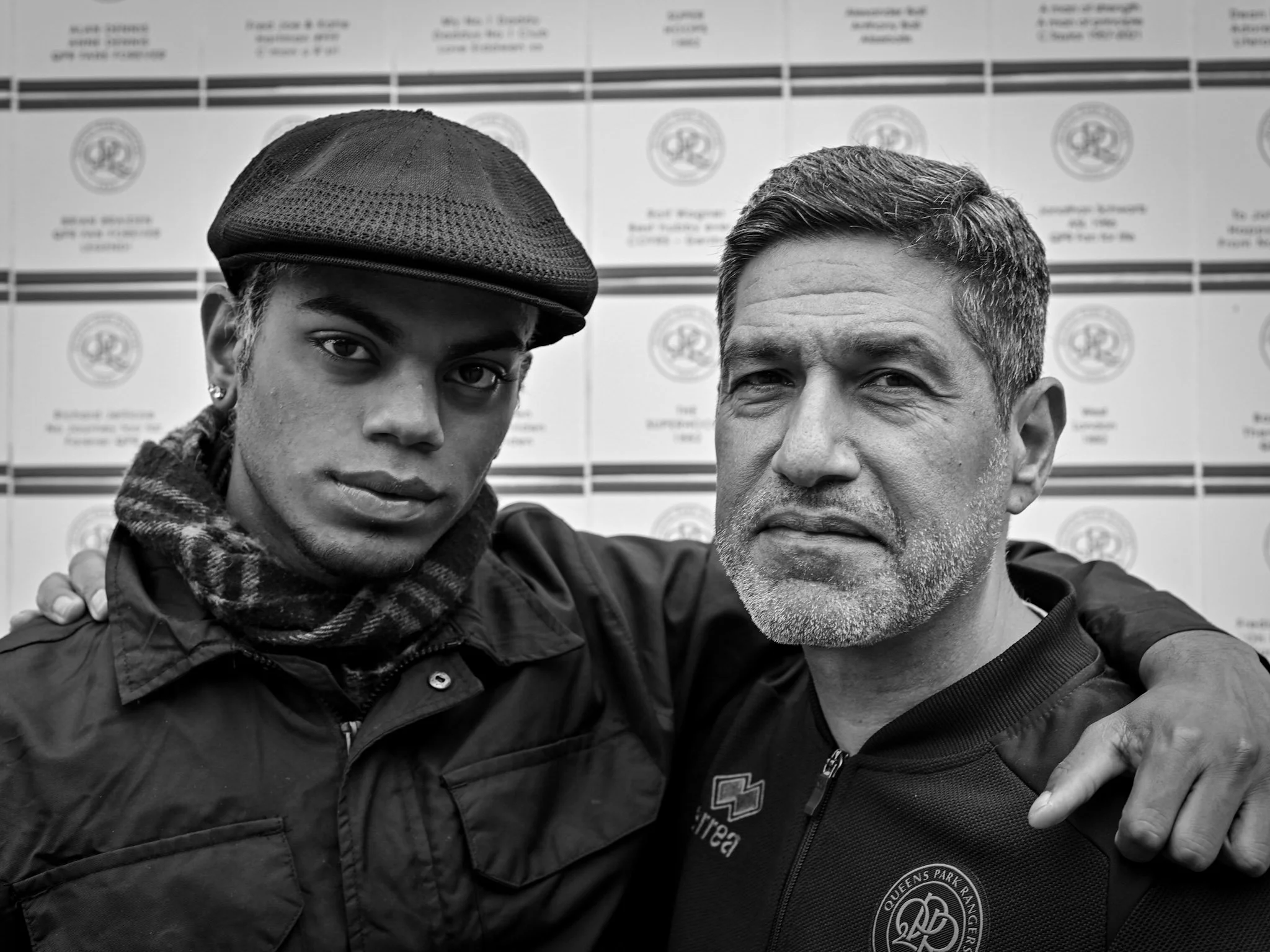
Murli and Kundan - “Belonging”
When I asked each of them to write a sentence about what the other means to them, framed (if they wished), around QPR, what came back said more than either of them perhaps intended.
Murli drafted and redrafted before settling on this: "Our father-son relationship has been strengthened by dealing with the highs and mostly lows of our love for QPR. I'm so happy to see him attend matches with his friends as I did at his age, and know that he is creating lifelong friendships and memories." When I asked him to distil his own childhood experience of the club into a single word, he didn't hesitate: belonging.
Kundan's response arrived differently. It was immediate, fully formed, and funny: "The first letters my Dad taught me to say were ABC - Anyone But Chelsea FC. Love you Dad! "
Together, the two statements describe the same relationship from opposite ends of it. Murli wrote about watching Kundan become who Murli once was. Kundan wrote about being made by his father. For Murli, QPR has functioned since boyhood as what we might call a holding environment; a stable structure through which identity and community could be felt before they could be named. Belonging was absorbed, not chosen. And now, watching his son build his own friendships through the same rituals, the same colours, the same turnstiles, he sees his own formation reflected back across a generation.
Kundan's ABC joke is doing something more subtle than it first appears. It tells us that QPR allegiance wasn't something he arrived at - it was something he was made from, encoded before memory. But the humour is the point too. Theirs is a relationship where love doesn't need to be solemn to be real. The declaration at the end “ love you Dad “ lands harder because of the laughter that precedes it.
The club, in the end, is almost incidental. It is the vessel, not the content. The content is connection, identity, inheritance, and the deep human need to know you are not alone in the world. That is what the photographs are trying to hold.
Max McGonigal © 2026
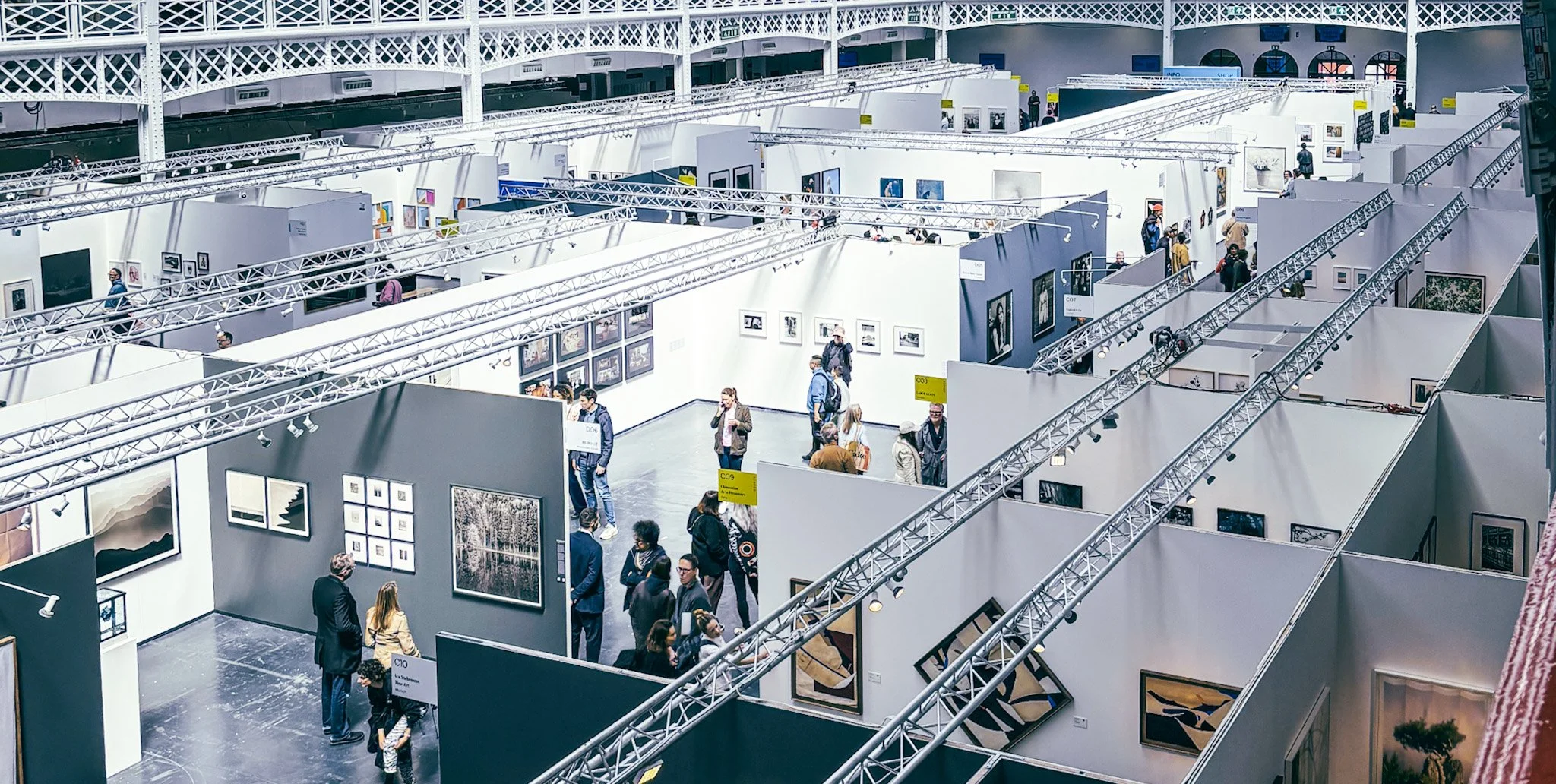
Photo London ‘26
What strikes you is how little changes: people, habits, environment, situation - all remarkably similar across decades and generations. It's thought-provoking on many levels, and I found myself seeing clear connections with my own My Father, My Son project and its themes of family and relationships. Wanda's stand was also painted a deep, warm red - it stood out beautifully against the sea of white around it.
"So, what was Photo London like?"
That's a very good question!
Cutting straight to it - it was, on the whole, a really good experience.
Yes, there were things that weren't so good, so let's start there and end on the highs.
The Negatives
It's quite pricey for what it is. My Friday ticket was £32, plus a £1 booking fee. That felt fairly steep - particularly as a Friday ticket only grants admission from midday, which compresses your visit into the afternoon. Photography talks were £10 each, which isn't bad in isolation, but I wanted to catch two on the Friday, so my total crept past £50.
It is expensive when you consider this is effectively a trade show for photography galleries and collectors. That said, the high pricing does achieve one thing: it thins out the crowd. It keeps away a lot of people who might otherwise come - students, enthusiasts, the general public. It was busy, but not as busy as it might have been had it been free, or say, £15 cheaper. I'll leave it to you to decide whether that's a good thing or not.
The lighting and glare issue. It's a bright hall, with generous natural light pouring through roof skylights. In many ways this is wonderful - far better than the flat, artificial light of some exhibition venues. However, very little consideration appears to have been given to glass reflection in areas exposed to that natural light. Some of the massive Steven Meisel prints were quite badly affected, which is surprising given that the framing on prints that size probably ran into the thousands - and yet low-reflective glass was nowhere to be seen, or at least not that I could tell. A lot of work on the main ground floor suffered the same problem, which was a shame and more than a little surprising given the price tags attached to many of the pieces.
The demographic. My observation of the crowd: predominantly middle-aged to senior, and heavily male. Rather depressingly, a lot like me - and it did give me pause. Walking in, I thought, "this is going to be really grim if it's the same crowd as a Dead Kennedys or PiL gig" (basically, everyone from 1986, just forty years older). I'm glad to report it must have been a coach party of sixty-year-olds bottlenecking the entrance, because it felt considerably less geriatric once I was inside.
Very little seating or food. For the amount of floor space, there's remarkably little to sit on or eat at. Seated areas do exist - tucked away near the book section - but they're easy to miss. My own lunch was a Sainsbury's chicken caesar wrap, bought strategically in Hammersmith, washed down with a bottle of fizzy drink. I knew I'd have a lot to cover and I like to keep moving, so it made sense.
The Positives
The location - Olympia. Perfect for me. It's an easy ten-minute walk from Hammersmith, or two minutes on the bus. I'd never been to Photo London before, so I had no nostalgic attachment to Somerset House, its previous home. Olympia is a big space, but not so big as to be overwhelming. You can comfortably cover the ground floor and upper deck in about two to three hours and feel you've seen the majority. Allow four hours if you want to browse the books and have a coffee. Add a talk or two and you're looking at a six-hour visit - but you'll leave with that satisfying "I've done it" feeling.
The breadth of discovery. I saw the work of 53 different photographers, many of whom I'd never encountered before. I'm not ashamed to admit I'm not academic about this, and I don't easily remember names unless I can build a visual frame of reference around them. This exhibition made that possible in a way that browsing online simply doesn't.
The variety was impressive too. From big names - Misan Harriman and Joel Meyerowitz were both present and doing live talks; Misan in particular was actively engaging with everyone who stopped to look at his work - to genuinely surprising discoveries. One that stayed with me was Wanda Martin, a Hungarian photographer showing The Ballad of Eternal Youth - a collaborative project in which her own contemporary work sits seamlessly alongside her father's photography, despite a forty-year gap between the shutter clicks. What strikes you is how little changes: people, habits, environment, situation - all remarkably similar across decades and generations. It's thought-provoking on many levels, and I found myself seeing clear connections with my own My Father, My Son project and its themes of family and relationships. Wanda's stand was also painted a deep, warm red - it stood out beautifully against the sea of white around it.
On that note: the exhibition did feel a little old-fashioned in its presentation - all large white boards, it had the feel of an upscaled degree show. But I don't think that's necessarily a bad thing. It kept the atmosphere relaxed, and it needed that, because this is ultimately a collector's exhibition - the kind where some of the photography costs as much as a Range Rover.
The archive work. Some genuinely wonderful capsule collections on show. Right by the entrance, there were beautiful prints by Ahmed Ali - including a photograph from 1952 of a miner drilling in a tunnel, and a wall-filling sequence called Assembly, documenting factory workers. Ute Mahler and Werner Mahler also had stunning archive work, including several beautiful black-and-white portraits from Mona Lisa's of the Suburbs (2010), featuring female subjects from across Europe.
My Shortlist - Photographers Worth Your Attention
Dileep Prakash - gorgeous print, The Anglo-Indians
Stéphane Couturier - colourful photographic montages that push into abstraction; almost paintings
Sakiko Nomura - My Last Remaining Dream (2018)
Eiji Ohashi - Roadside Lights #155 (2026)
Laurence Demaison - Vanité (2023); 3,132 pins, painstakingly assembled - a genuinely unique piece
Weronika Gęsicka - Cliff Hanger, Smash, Holiday, Cocoon, Fun & Games (2019–2023); darkly funny photo-manipulated images with a strange dystopian undertow.
Joseph Rodriguez - East Village, Outside the Vault, Happy Camper, Homeless Family (1984); sensitive, candid, occasionally funny archive work. Loved these.
Anne Bean - Divided Self (1974–1982); montage work that took me straight back to things I dabbled with at college in the eighties.
Tom Wood - Me and My Mates (1975); more brilliant archive. I am clearly and unapologetically drawn to 1970s and 80s documentary and portrait photography.
Jane Evelyn Atwood - a must-research photographer. Her 1976–77 Paris work - apparently shot in a brothel - is extraordinary. Three Women in a Stairwell and Claudine Goes Downstairs are exactly the kind of photographs that make you wish you'd taken them.
James Clifford Kent - a must-research photographer. Her 1976–77 Paris work - apparently shot in a brothel - is extraordinary. Three Women in a Stairwell and Claudine Goes Downstairs are exactly the kind of photographs that make you wish you'd taken them.
Janet Delaney - Too Many Products, Too Much Pressure; a lovely set of photographs of her father and his work around the family beauty salon.
James Clifford Kent - a small stand near the Meisel work, but a real discovery. His Cuba project is just wonderful. Firmly on my research list.
Thomas Duffield - for his work exploring his relationship with his father. A small stand, but I stood in front of these photographs for a long time.
Indu Antony - her photographs of Cecilia are worth seeking out: humorous, sensitive, bold, and surprising. The written text adds an extra layer that rewards attention.
The Talks
I attended the Jess T. Dugan and Charlotte Cotton talk and got a great deal from it. I hadn't come across Jess's work before, but I was immediately struck by it - the portraiture is so sensitively made. I had the chance to ask about the ethics of photographing family and presenting that work publicly, and Jess's reflections on this were genuinely useful. A lot of what I make is about my own family and close relationships, so these were real take-aways.
And a final, well-deserved shout-out to Antony Cairns, who was running a live studio recreating night scenes using old computer punch cards from the 1970s. His work is really worth checking out.
Thank you for your attention in this matter.
Max McGonigal © 2026
Brockwell Pat
We walked up the hill towards Brockwell Hall, which dates back to 1811. There’s some nice pathways with covered benches (the sort you sometimes see in seaside towns) and one became a location for a couple of photos. We talked about getting older, health issues (including a trapped thumb in a door), friends we hadn’t seen for a while, family, pets, music bands we want to see, the Derby (horse racing).. All the important and not so important stuff basically. A funny and sometimes serious conversation that made meeting up special and reminded me that I need to make the effort more often, as I really enjoyed it.
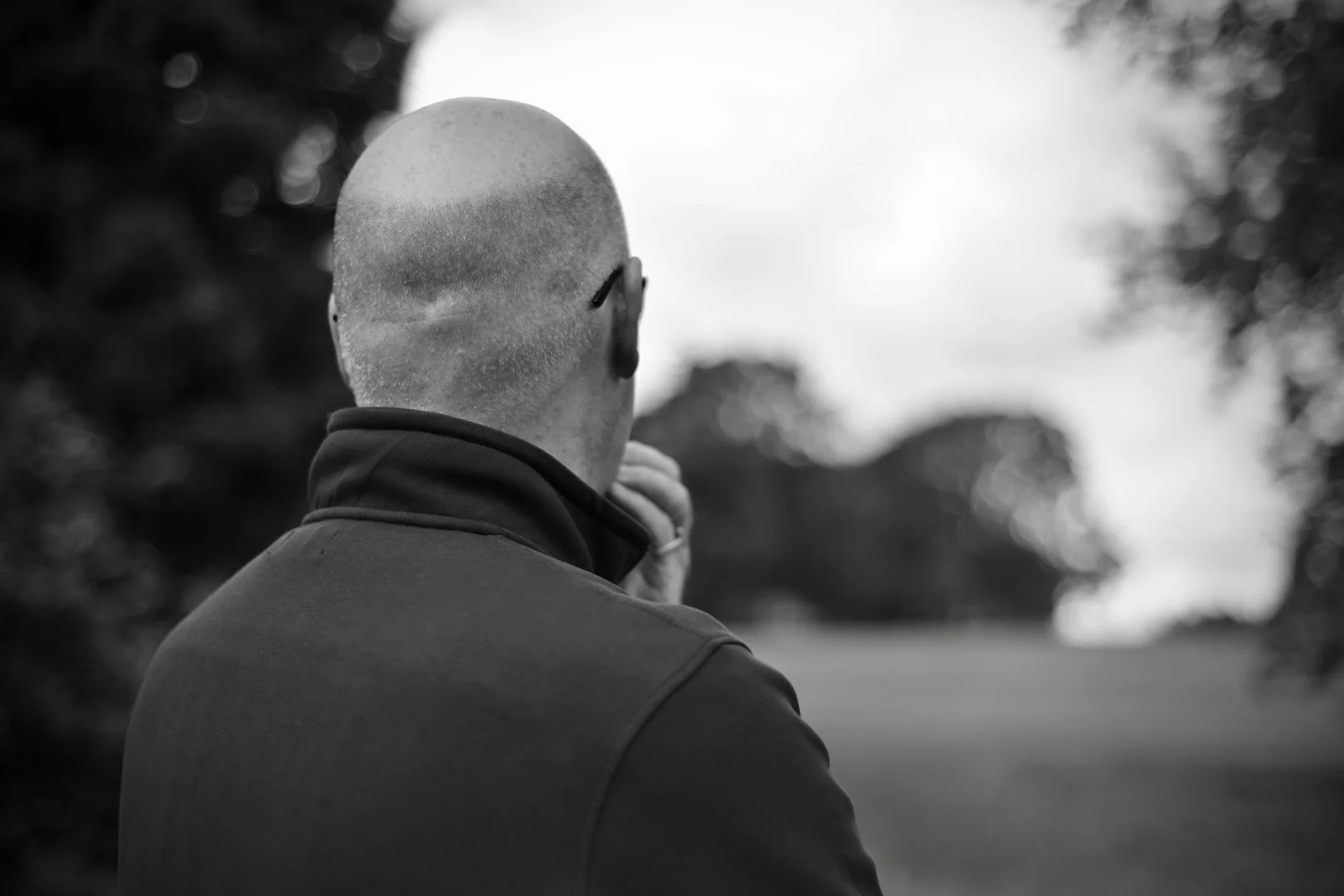
Brockwell Park - 6th June.2025
I made a flying visit to Herne Hill to visit my friend Pat on Friday.
We met at Polytechnic in Hull many moons ago. Pat originally hails from Tipton, in the West Midlands, referred to as the Black Country. Now he lives close to Brockwell Park in the leafy borough of Lambeth..
I remember speaking to Pat about my teenage years living in South London. It must have made an impression as he consequently moved here, an area that is a short bus journey from where I used to live (Streatham) in the 80’s.
The locality of the station is not what I remembered however. The area is firmly gentrified and very middle class these days. I think I counted three parent bicycles within the first few minutes of exiting the station (the ones with the big box on the front, intended for a couple of infants and a waitrose bag or two).
After a stop at Gail’s, for two coffees, a smoked ham and cheese croissant and two (most excellent) cinnamon swirls (£22.50!!), we headed to Brockwell Park to walk off the swirls, continue our conversation and possibly find a location for a photo or two.
Brockwell was partially sectioned off due to the numerous summer events going on there - a subject of much discussion in the local community, as it can be noisy and the footfall has dramatically increased in the last few years.
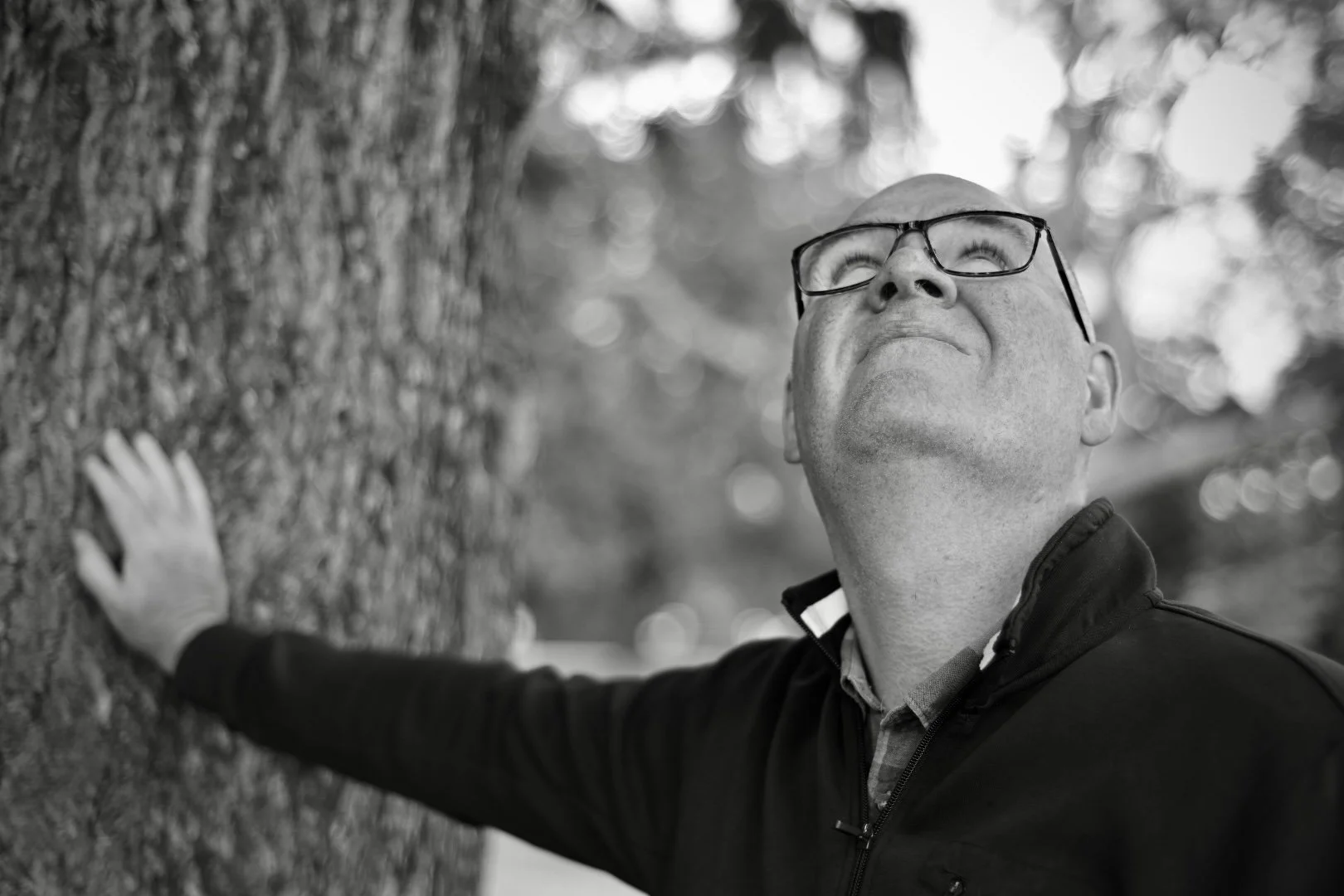
Brockwell Park with Pat, under a Cedar of Lebanon. (Thankfully no pidgeon droppings!)
We walked up the hill towards Brockwell Hall, which dates back to 1811. There’s some nice pathways with covered benches (the sort you sometimes see in seaside towns) and one became a location for a couple of photos. We talked about getting older, health issues (including a trapped thumb in a door), friends we hadn’t seen for a while, family, pets, music bands we want to see, the Derby (horse racing).. All the important and not so important stuff basically. A funny and sometimes serious conversation that made meeting up special and reminded me that I need to make the effort more often, as I really enjoyed it.
We took some more photos near a temporary security fence, and near an old victorian horse watering point. The locations lent themselves to the conversation and the subsequent photographs, which can be found on the portraits section of the portfolio. These are digital b/w (ND780) with a combination of 85mm and 50mm lenses.
Clapham with Matthew
Looking at the photographs now, I can see the conversation in his face, the cheeky smile in one shot, the subtle tilt of his head and the expressiveness of his eyes in another. I was pleased with the photo’s I was taking, and after about 20 minutes we wrapped it up and headed to the station.
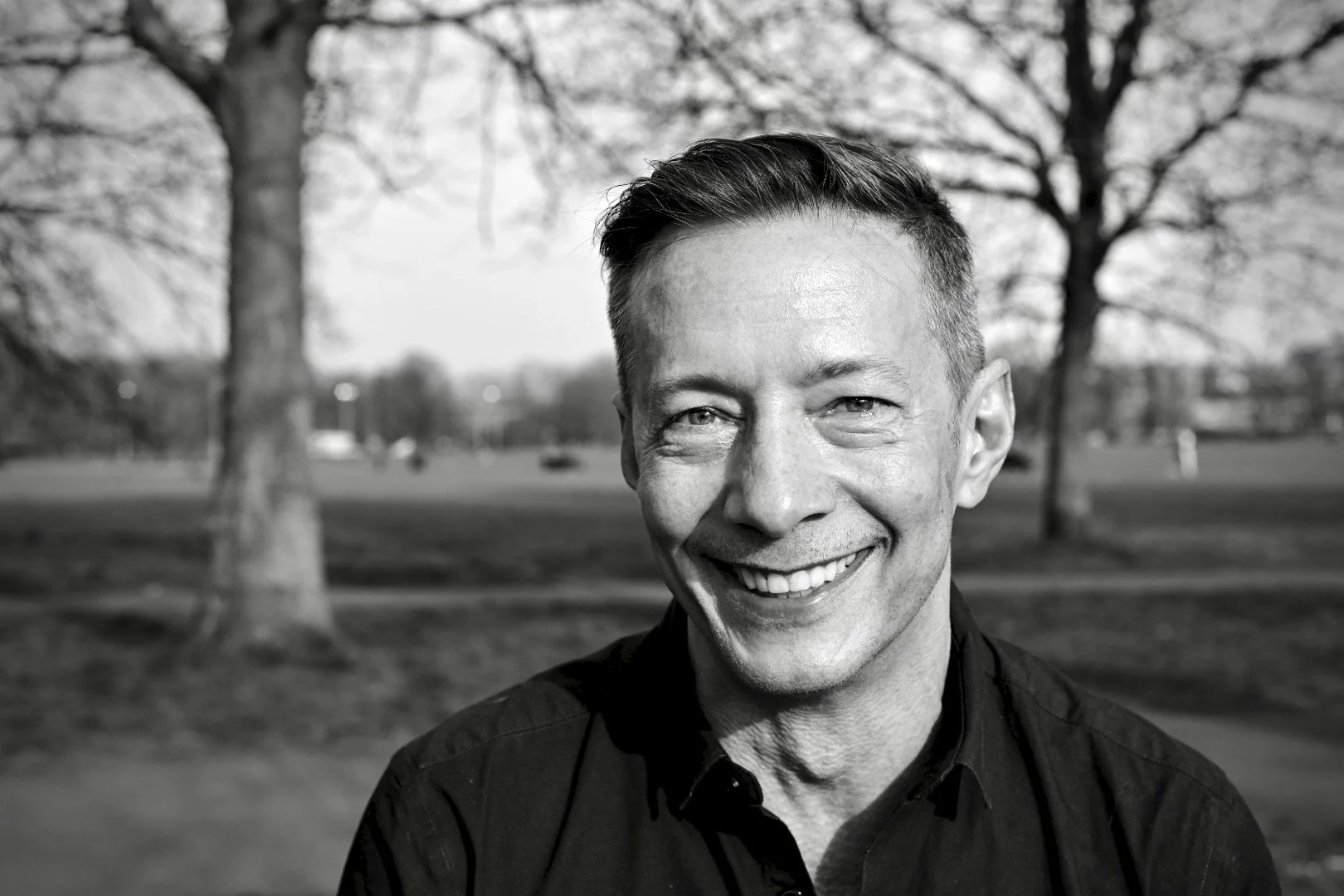
Clapham Common - 21st March 2025
Catching up with old school friends is not an everyday activity, and something that needs planning. Matthew and I had traded text messages and I was excited about the two of us meeting-up. It’s a little difficult to get hold of Matthew these days as he has intentionally limited his exposure to social media platforms.
We arranged to meet in a gastro pub near Clapham Common. It was a pleasant space, quite big with lots of natural light flooding through the big pub windows to the front. It was really quiet however, so I felt a little conspicuous being the first to arrive. The light could be really nice for a couple of photo sketch portraits I thought... but in the end I decided against it. Better to relax and discuss the possibility of taking some portraits later, and where to do them.
I have known Matthew since 1978. We met at secondary school in Fulham. And now, here we were catching up again,.. like it had only been a few days ago.
I’ve always found it very easy speaking to Matthew. He has a real openness about him. To me, he seems to really wear his heart on his sleeve. And what an incredibly strong and inspiring sleeve and heart combo that is!
We had a tasty lunch, chatted some more, and then decided to head over to Clapham Common, as the light was still good and I wanted to get just a few head shots at the very least. He wanted to purchase a birthday card on the way, so we ambled and chatted as we took the detour.
We walked until a park bench presented itself. The light was a little soft by now, with some drifting fluffy clouds and the light kept changing and this potentially might make the photos more interesting. I had to change my angle and height a few times, and moved around him. Matthew was completely at ease with me and we chatted idly, giving him time to reflect on my questions and allow those feelings to be in his eyes and expression.
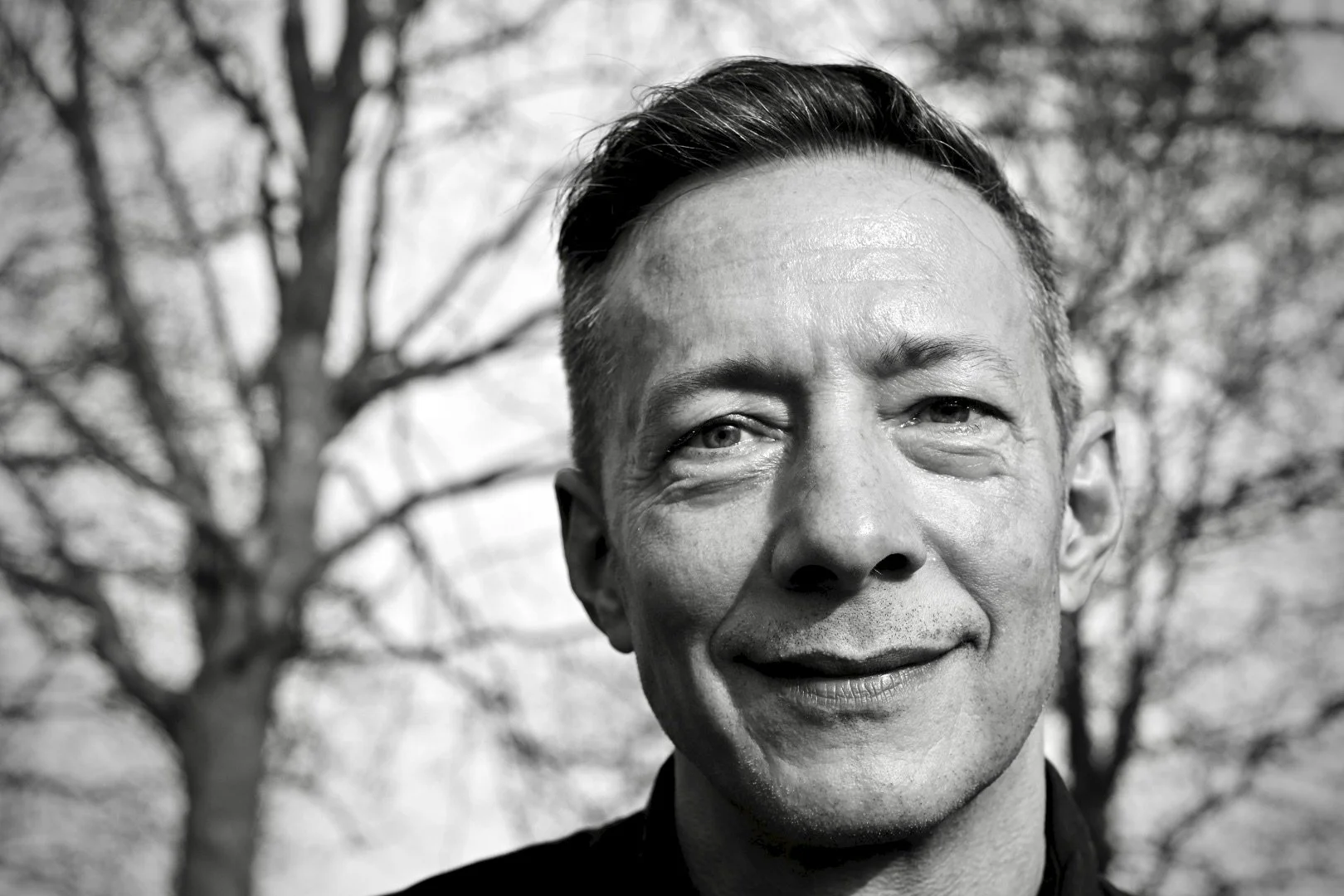
Looking at the photographs now, I can see the conversation in his face, the cheeky smile in one shot, the subtle tilt of his head and the expressiveness of his eyes in another. I was pleased with the photo’s I was taking, and after about 20 minutes we wrapped it up and headed to the station.
We agreed not to leave it so long until the next time, and with a hug and a deep breath of lifelong friendship we went our separate ways.
(More photos from this session can be found on the portfolio pages)
Max McGonigal (c)2025