A 10 Minute Conversation
A few days ago I spoke with Professor Daniel Miller, who is Professor of Anthropology at University College London. I had recently read a book he wrote 15 or so years ago, The Comfort of Things, which I am now using as a reference as I develop my new idea for a photography project: What We Carry.
I loved reading about the different people he had interviewed as part of his research for the book, but there were questions that I had which could not necessarily be answered by the text. Things like his approach to gaining the trust and engagement of the people he met, and access to their personal homes. So, I contacted Professor Miller and he kindly agreed to a "10 minute conversation."
That '10 minutes' gave me a massive download of useful data, and most importantly a perspective that singular thought and consideration alone cannot give. I was quite nervous, if I am honest. It's not every day you meet one of the world's leading voices in the field of anthropology, and even though it was a Zoom call, I had butterflies. I had devised a list of questions, but I knew they might be curtailed by the limitation on time. After a moment of technical issues with cameras and sound, I introduced myself and moved directly to why I had asked him for a quick call. This context was important. I correctly understood that he needed to know he wasn't wasting his time, and I needed to give him something he could engage with. My introduction briefly covered my MA studies, my recent photographic project, the unexpected inheritance of my father's photographs and ashes, and the new project as an offshoot of this experience, which is concerned with our relationship with inherited objects. He listened patiently, and then immediately gave me a list of references suitable for further research, including papers in the Journal of Anthropology by his long-time colleague Fiona Parrott, and other academic writers including Craig Ryder and Sophie Woodward. Once I had noted these references, he moved on to share his thoughts on conducting interviews, and how to get the very best out of those encounters. What he gave me made perfect sense, and although it was not rocket science, it still needed him to say the words for the understanding to land. Be authentic, be genuine, explain why you are talking to them and show that you are interested. They in turn will talk to you. More than that, they will want to talk to you, because you have gained their attention and are showing a focused interest in what they have to say. You still have to convince people, but if you can be honest with them, they will speak to you, or in my case, allow me to photograph them.
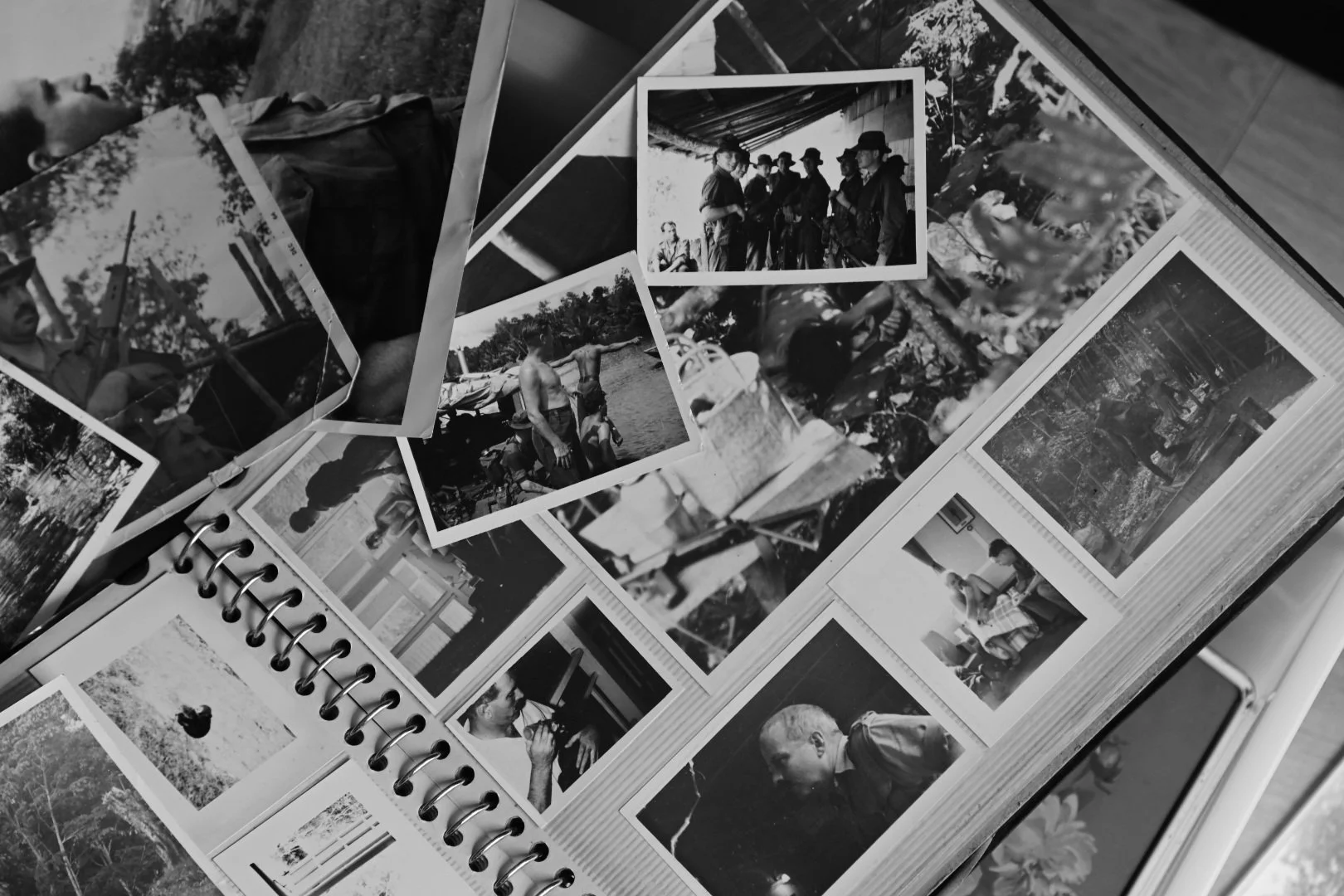
Some of the many inherited photographs that belonged to my father.
I have no idea if he looked at my website, and I didn't ask. This was a powerful conversation and the clock was ticking. Professor Miller spoke about the benefit of conducting research with a colleague, and again this made perfect sense. He explained that some subjects felt more at ease with his colleague, while others were happy to engage directly with him. Sometimes they took it in turns to ask questions, so that the other had time to process and formulate the follow-up. I immediately thought of a book I had read a few years ago, Never Split the Difference by Chris Voss, an ex-FBI hostage negotiator, who always drew on the observations of a listening colleague to gain a wider perspective, one that is not always apparent when you are entirely focused on the conversation itself. He went on to say that it was also beneficial to discuss the encounter with a colleague immediately afterwards, as a way of reviewing the conversation and identifying the most important takeaways. But in my case, I would not have a colleague. I operate on my own, and have no one to bounce off or talk to afterwards. However, perhaps that other person, in my case, is the camera itself. The conversation I have later will be the photographs, and I can see what they say to me. In my last project, the request for the participants' own written words also added that other voice. It allowed the subjects to reflect on their relationship and ask the question of themselves.
The conversation moved to ethics. I brought it to this, as I wondered how, and if, there had been any issues with subjects perhaps changing their minds about being included in his studies. Professor Miller anonymises his subjects to protect them, which is something he can do fairly easily, but in my world, where I am making photographs, that is not straightforward. He did not have a direct answer to that, but pointed out that there is a problem with focusing entirely on gaining consent, and that it can itself become a barrier to saying anything negative. The point being that too much caution can lead to sanitising the truth of a story. Which made me think that consent to photograph is not just a single event, but something that must be continuously renewed. In my next project, What We Carry, consent may become an ongoing negotiation rather than a signed form.
I looked at the clock. It was 12 minutes past the hour, and 2 minutes over our allotted time. I asked if I could follow up with him after I had made a start on the project, thinking he might be interested to see what I had done with the ideas we had discussed. He declined politely, explaining that he had two MA courses to attend to and received approximately 30 requests a day for interviews. I thought: I was fortunate to have had even this brief conversation. And with that, it ended.
© Max McGonigal 2026
