Sunday morning, and as I glanced at the clock my mind turned to the day ahead. If all went well, I would be adding to My Father, My Son with photographs of my next-door neighbours, Mike and his son Macgregor.
We moved to our street in 2016, and Mike, his wife Sara and Macgregor made us feel very welcome. It is a friendly street with a real sense of community.
I had spoken to Mike and Macgregor a few weeks earlier about taking part in the project. I was thinking of moving it in a more community-focused direction, and thought they might be interested. Mike is in his 60s and Macgregor is in his late twenties. I knew they were a creative family: Sara is an experienced furniture upholsterer, Macgregor is into videography and editing, and I often hear a piano or guitar drifting over from next door. I was about to find out how much more there was to it.
We had arranged to meet at 11am. I got my cameras ready: a digital Nikon, my father's old Yashica 124G, another Nikon film camera and a Pentax 6x7. Perhaps a little overkill, but I have realised that I enjoy working in film as well as digital, and I love having a mix of negative formats. It makes the experience exciting. Each camera, with its lens, weight and handling, changes how I move around and creates variation in how I photograph a subject. The sun was poking through the clouds, so the weather looked promising.
Mike welcomed me in and I went through to the kitchen, where Macgregor was finishing a bowl of cereal. I couldn't remember exactly what I had told them about the project, so I gave a brief overview of what I hoped to achieve with their help. They listened and responded positively to the ideas and to what I had done so far. Then I explained that I would like to include a personal statement from each of them about what is different or special about their relationship.
Almost immediately we were talking about their common bond, a shared sense of humour, and their love of old films. Peter Sellers and Inspector Clouseau came up first, films they watched over and over growing up. "We just say one line, and we both laugh," Mike told me. Macgregor described how it plays out now: after time apart they skip the "how was your trip?" and go straight back to "riffing off old impressions" of the films they grew up on.
The conversation was moving faster than I had expected, so I asked if they minded me recording it on my phone, and both were happy for me to. I have not done this on previous shoots. It simply hadn't occurred to me, but I realised it would let me refer back to the conversation later, and it might spare me from formally asking for written statements, which can take people a while to produce because it doesn't come naturally. I put the phone on the kitchen table and the conversation carried on. Partway through, Macgregor asked me to check it was still recording, which told me he wanted their words kept.
Mike likened the two of them to "buffoons", the sort who would turn up at the tennis club with the wrong gear and never actually play. They talked about their creative outlets, the many instruments that Mike likes to play, and the skate videos they used to edit together when Macgregor was younger, choosing the songs that would become the background music.
When the conversation came to a natural end, I suggested we take some photographs. The late morning sun was now streaming through the front bay, creating pools of warm light on the floor and furnishings. Their living room is compact but beautifully furnished, with intentionally mismatched chairs, rugs and footstools. The walls are covered in pictures and prints, and there are some lovely instruments too. A cherry Gibson semi-acoustic hung on one wall, facing an upright piano, and a double bass lay in the shadows of one corner beside some house plants. It felt very comfortable and familiar.
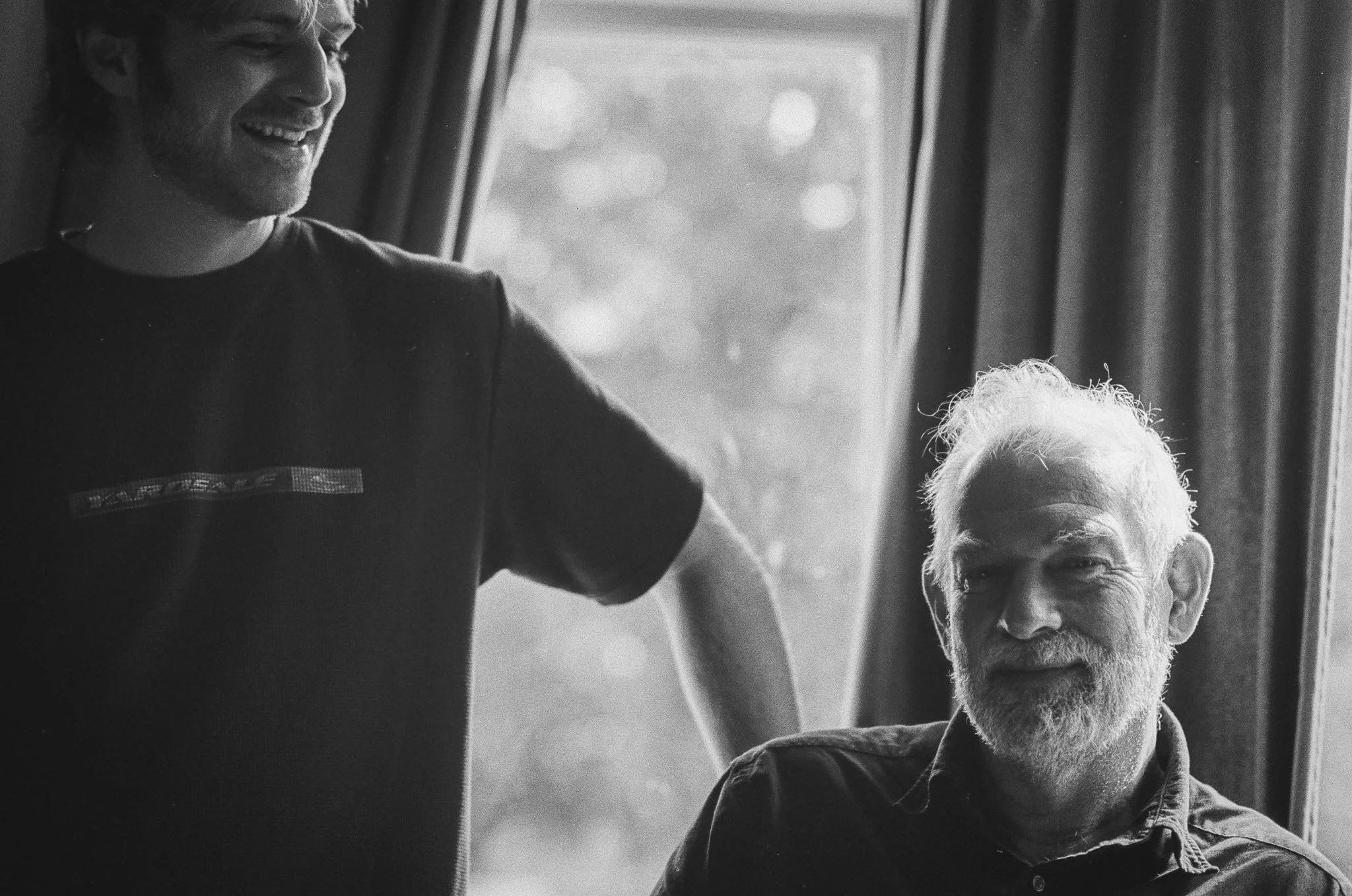
Knowing, without words.
I asked Mike to sit in a high-backed chair in the bay, while Macgregor took a wide armchair at an angle to him. I talked as I shot. This does not come naturally to me. I tend to lose track of what I am saying and often think afterwards that I talked absolute nonsense. But they seemed to respond to my words and comment back, which made it easier to move around the space. At one point Macgregor noticed I was using my dad's camera and said how much he liked it. That gave me the chance to explain the camera's significance and the impact my dad has had on the project. It seemed to resonate with both of them.
I started with a few quick frames on the digital, then moved to the Yashica and on to the Pentax, with its great 'ker-plunk' shutter. After I finished those rolls of 120, I grabbed the film Nikon and shot 36 exposures of various details and different angles, using an 80mm and a 28mm lens.
I took light readings as I went, but the sun was bright in the pools and I was shooting into it to some degree, so I am a little nervous about the results. I said so at the time, and Mike and Macgregor were quick to say they would be open to a re-shoot if needed. I thanked them and told them how much I had enjoyed it. Once the film is developed, I'll report back on how the exposures turned out.
Then I nipped back next door, took the exposed rolls out of the cameras and put the gear away. Next on the list was my stepson Sam's 15th birthday BBQ, so I set about prepping the garden. I was lost in thought for a good while, considering the photographs I had taken, the possibilities, their place in the project and what might come next. The day before I'd spent a couple of hours walking around the World Press Photo 2026 exhibition in Bermondsey, with my old friend Trevor. Trevor had mentioned he may be able to introduce me to two potential fathers who may be interested in being a part of the project. I was so excited at the prospect, so I shall need to give him a call to follow up soon.
This community, my friends, my family: these are the things that mean everything to me.
Max McGonigal © 2026
